
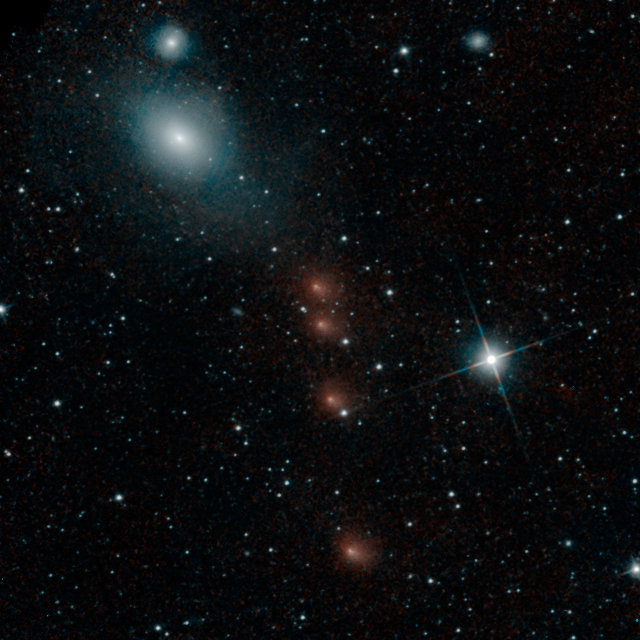
Yesterday the comet C/2013 A1, also known as Siding Spring, passed very close to Mars. The distance from the planet was as low as about 140,000 km (about 87,000 miles), one third of the distance of the Moon from Earth, very close in astronomical terms. The event was followed by several telescopes but nearby ther was was the Earth’s “star fleet” consisting of NASA’s probes and rovers, ESA’s Mars Express probe and the Indian MOM – aka Mangalyaan – probe.
Discovered on January 3, 2013, the comet C/2013 A1 Siding Spring comes from the Oort cloud, the cloud of comets that according to astronomers could exist at the edge of the solar system. Its distance from the Sun is thousands of times greater than that of Pluto so it’s impossible to see the comets that make it up. This makes it difficult to confirm its existence, however, comets keep on coming in the inner solar system so there must be something!
The origin of comet C/2013 A1 Siding Spring makes it more interesting than ever. Comets are generally fossils of the first phase of the solar system’s history, the ones that come from the Oort cloud may have been unchanged or barely changed for a few billion years.
It wasn’t possible to see the comet C/2013 A1 Siding Spring with the naked eye from Earth but many telescopes have already started observing it for some time. The various space probes in orbit around Mars have also tried to carry out analyzes of the dust and gas that fell into the atmosphere of the red planet.
It’s a truly unique opportunity to analyze a comet at close range, so much so that some of the Martian space probes have been moved to avoid the risk of being hit by part of its tail. Those are small particles but the comet C/2013 A1 Siding Spring travels in a direction opposite to Mars therefore the speed relative to the planet is about 190,000 km/h (about 118,000 mph). Even dust can be dangerous due to the kinetic energy it would have in its impact with a spacecraft.
After the passage of Comet C/2013 A1 Siding Spring, NASA has confirmed that its space probes have suffered no damage. MAVEN started studying the possible effects of gas and dust from the comet’s tail on the atmosphere of Mars. Probably the first images and analyzes will start arriving in the coming days.
[ad name=”eBayUSUKAstronomy”]

Permalink
Permalink