
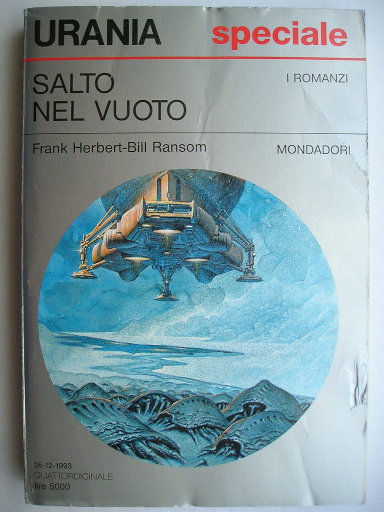
The novel “The Jesus Incident” by Frank Herbert and Bill Ransom was published for the first time in 1979. It’s the sequel to “Destination: Void“.
Ship brought its crew in the Tau Ceti system and a colony was established on the planet Pandora. It’s far from a paradise, with native life forms lethal to humans who are somehow interconnected and they’re connected to the mystery of the Avata. Life for humans and clones is hard and Ship isn’t happy.
The settlers had to decide how to WorShip but what’s happening isn’t satisfactory. To change the situation, Ship awakens from hibernation Raja Flattery, the first chaplain-psychiatrist, and reveals him the nature of the test it’s conducting. Raja must help the settlers to pass the test, otherwise Ship will eliminate the colony.
More than a decade after writing “Destination: Void”, Frank Herbert took up the story, and this time together with his colleague Bill Ransom started writing a trilogy of sequels. In the story, an indetermined amount of time passed after Ship reached the Tau Ceti system and the crew founded a colony on one of its planets, called Pandora. It’s a hostile world, on which there are life forms dangerous for humans.
In the chilling end of the first novel, Ship became sentient due to the creation of an artificial consciousness and told the members of its crew that they must decide how to WorShip. The religious theme was already present in “Destination: Void” but in “The Jesus Incident” becomes paramount. Ship is the God-Emperor of Pandora, directs the lives of the settlers and creates clones with genetic modifications to experiment with variations of the normal human form.
In many ways, “The Jesus Incident” takes up the themes of the previous novel mixing them up differently. In this case, the setting is vast and there are many more characters – maybe too many to have the protagonists developed at their best – for a number of subplots that make the story really complex. The relationships within the colony are difficult, also because the clones are victim of racism.
In “The Jesus Incident” there aren’t just a few people under great stress forced to go beyond their limits but there’s a small society in which there are struggles for power and resources. In this situation, some people who are recognized as leaders influence the others for good or bad. These developments of the typical themes of Frank Herbert are closer to those seen in the Dune series than in the Pandora series.
All these factors make “The Jesus Incident” intriguing but the flaws seem similar to those of “Destination: Void”, in particular with regard to the plot fragmentation. The stories of various protagonists sometimes seem to go in different directions, making the novel not very smooth.
The good thing is that in “The Jesus Incident” the pace is often much faster than in the previous novel. In this case, the plot is carried out by the events and not only by the conversations among the characters. This is one of the most profound differences from “Destination: Void”, which was set in the the ship.
Unlike the first novel, “The Jesus Incident” was created as part of a series so it has an ending but it leaves a lot open to its sequels. For this reason, it’s best to also read the two other novels to know how the story goes on.
“The Jesus Incident” and the rest of the WorShip series are certainly not as famous as the Dune series but a small cult was born around them. The result is that elements of these novels have influenced some videogames. The movie “Avatar” also seems to have gotten inspired by this cycle for some elements of the planet Pandora, though the story of the movie is basically a science fiction version of Pocahontas.
Despite the significant differences from “Destination: Void” overall I had from “The Jesus Incident” impressions in many ways similar. It seems a bit of a hit and miss, even if the elements that work or don’t work are not exactly the same as the first novel. It’s almost paradoxical that the result is both very similar and different.
The bottom line is that my opinion of “The Jesus Incident” is similar to that of the previous novel. Again, because of its particularities I recommend it to Frank Herbert fans, who already have a certain attitude to his typical themes, and those who appreciate the kind of topics addressed.
