
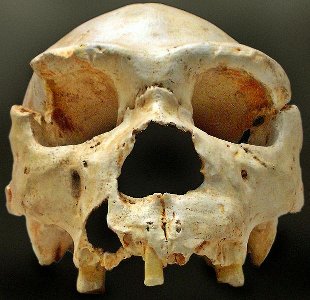
An article recently published in the journal “Nature” describes the study of the DNA of hominids found in a place in northern Spain called Sima de los Huesos, which means pit of bones (skull photo ©José-Manuel Benito). The DNA analysis of these fossils of hominids who lived between 300,000 and 400,000 years ago established that they are an early form of Neanderthals. According to paleogeneticist Matthias Meyer of the Max Planck Institute for Evolutionary Anthropology in Leipzig, Germany, the results suggest that the ancestors of homo sapiens separated from those of the Neanderthals and another species called Denisovans between 550,000 and 765,000 years ago.
The completion of the analysis of the mitochondrial DNA of these fossils was announced in 2013 showing various surprises. In particular, the researchers noticed unexpected genetic similarities with the Denisovan, a species of which only a few bones have been found so it’s still poorly known.
Sequencing such an old DNA is a very complex deed because it’s now fragmented. The most modern genetic techniques allow to sequence even small pieces of DNA that’s now degraded and after two years of hard work Matthias Meyer’s team successfully sequenced enough DNA found in a tooth and a leg bone of these hominids.
The genetic code of these hominids is still incomplete but enough was sequenced to compare it with that already found in previous research on other hominids and that of homo sapiens. It was possible to establish that the inhabitants of Sima de los Huesos shared many more unique genetic characteristics with Neanderthals than with Denisovans or homo sapiens.
Matthias Meyer’s conclusion is that these hominids were early Neanderthal or at least they were related to them. This and other considerations were presented in recent days also at the fifth annual meeting of the European Society for the Study of Human Evolution.
One of the deductions that it’s possible to do on the basis of these results is that Neanderthals separated from homo sapiens earlier than previously thought. Mutations rates are only estimates so the period in which the two populations started to turn into different species is estimated with approximation, between 550,000 and 765,000 years ago.
This new hypothesis changes significantly the human family tree. Further research will be needed to establish more precisely the time of the evolution of the various species but this will take time because the fossils are very old. Finding other bones of the various species would be helpful, hoping that in the meantime genetic techniques keep on making progress.

Permalink
Permalink