
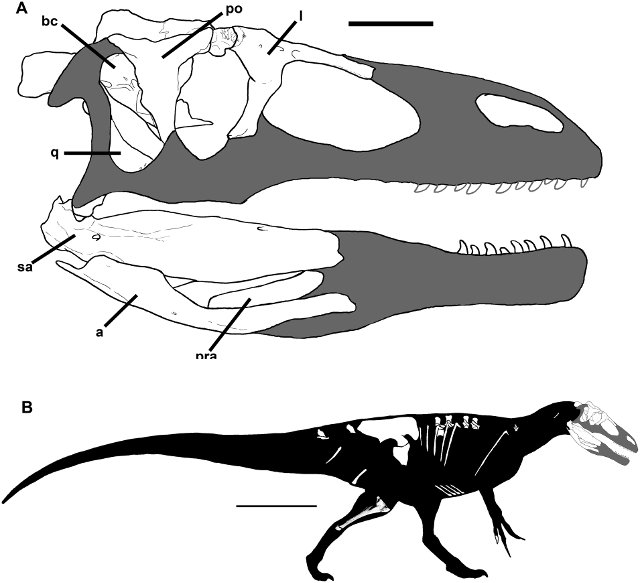
An article published in the journal PLOS One describes the discovery of a new species of theropod dinosaur that was called Murusraptor barrosaensis dating back some 87 million years ago, in the Late Cretaceous. Two paleontologists identified it as a megaraptorid, a group of large carnivores whose classification is controversial. This new discovery could help to better understand the relations between different groups of theropods.
Megaraptorids (Megaraptoridae) are a group of medium-large carnivorous dinosaurs with powerful claws and bones that were hollow and full of air, such as those of their distant cousins birds. A partial skeleton of Murusraptor barrosaensis was discovered in Sierra Barrosa, in the northwest of Patagonia, Argentina, a land where many fossils of dinosaurs have already been found.
The specimen discovered doesn’t seem to have yet reached adulthood but it’s estimated that it was already about 8 meters long. It shows signs of serious infections on the left side of its braincase. Two teeth marks, inflicted by another theropod, are visible on the ridge at the back of the skull, just above the neck. The infections caused deformities to the back of this Murusraptor barrosaensis’ head but it’s unclear if they contributed to its death.
According to the paleontologists it might be bigger and leaner than Megaraptor, a cousin that also lived in Patagonia in the late Cretaceous period. Its size may be similar to those of two other cousins that lived in that area and at that time, Aerosteon and Orkoraptor.
One of the main problems in classifying the group of megaraptorids and its relations with other theropods is due to the fact that paleontologists have several partial skeletons available. That of Murusraptor barrosaensis is one of these cases and it’s a stroke of luck that its skull is almost complete as it’s the only one of a megaraptorid found so far.
The other bones found can provide important information about its anatomy that could give some answers to the many questions about this group of carnivorous dinosaurs. In particular, Rodolfo Coria from the Consejo Nacional de Investigaciones Científicas y Técnicas, Argentina, and Phillip Currie from the University of Alberta, Canada, the two authors of the article, compared them with those of Megaraptor.
The main question that feeds the debate among paleontologists is: are megaraptorids a group that is part of the larger one of allosauroids (Allosauroidea) or that of coelurosaurs (Coelurosauria), which also includes Tyrannosaurus rex? The discovery of Murusraptor barrosaensis has already helped to clarify certain anatomical details of megaraptorids but not their exact classification. In the field of paleontology research often proceeds in small steps through each new discovery and that’s the case too.
