
An article published in the journal “Science” describes a genetic analysis of members of the pygmy population living on the Indonesian island of Flores. A team of researchers tried to understand the origins of their short stature and the possible relationship with Homo floresiensis, the hominins nicknamed Hobbits who lived on the island in the past, concluding that there are no traces of genetic links between the two populations, in which short stature is independent, a typical case of adaptation to life on an island.
Starting from 2003, fossils belonging to various individuals of a hominin a little taller than a meter were discovered in a cave of Liang Bua on the island of Flores. The nickname hobbit given to the species later named Homo floresiensis sparkled the public’s imagination but in the scientific field discussions on its origin and on its relationship with Homo sapiens continues. An article published in April 2017 in the “Journal of Human Evolution” described a study on its bones, offering some answers and a possible position in the evolutionary tree of hominins.
On the island of Flores a population of pygmies is currently living and one of the possibilities taken into consideration was that there were some interbreedings with Homo floresiensis. Unfortunately, any attempt to recover DNA fragments from hobbits’ bones failed so a direct comparison is impossible, however a team of scientists led by Joshua Akey, professor of ecology and evolutionary biology at Princeton University, invented a genetic technique to find archaic sequences in the DNA of a modern species.
In simple terms, the DNA of 32 pygmies living in the village near the cave of Liang Bua was analyzed to verify the origin of their genes in the hope of finding some of which it was impossible to establish it. This wouldn’t be a final proof of interbreedings with Homo floresiensis but would suggest at least an interbreeding with a species of hominins of which we don’t have any DNA and therefore at least the probability that it’s the mysterious hobbit.
Serena Tucci, an associate researcher at Joshua Akey’s laboratory and one of the study’s main authors, explained that Neanderthal genes and also some of Denisovans, another species of hominins that interbred with Homo sapiens, were found in the DNA of the pygmies. These are results that the researchers expected knowing modern humans’ migrations. No groups of genes of unknown origin were found.
DNA analysis of pygmies revealed some evolutionary adaptations related to diet and short stature. The tendency to become smaller is typical in species that remain isolated on islands, generally linked to limited resources and to the scarcity of predators. In ancient times, dwarf elephants lived on the island of Flores.
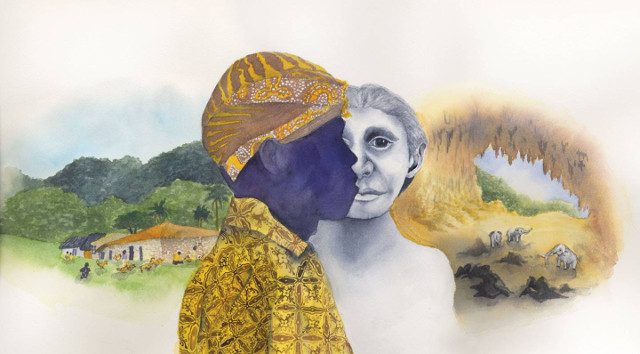
The image (courtesy Matilda Luk, Office of Communications, Princeton University. All rights reserved) illustrates from left to right the village of Rampasasa, where today pygmies live, a pygmy wearing a traditional head cover, the reconstructed face of a Homo floresiensis and some pygmy elephants.
In the end, according to the DNA study of the pygmies, there was no interbreeding with Homo floresiensis. Anatomical differences were already detected in addition to the fact that the hobbits were really short, around 106 centimeters, while the pygmies have an average height of 145 centimeters. This new research brings a new confirmation of the fact that even hominins become smaller if they live on an island, just like the other animals.
