
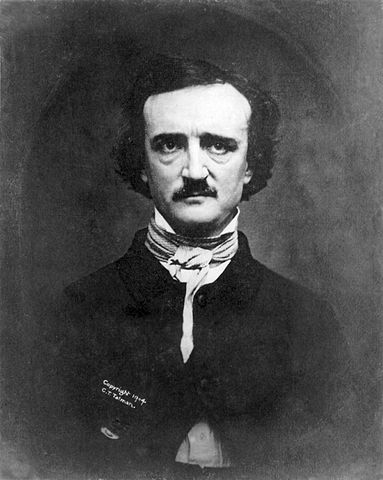
Edgar Poe, this was his birth name, was born on January 19, 1809, in Boston, Massachusetts, USA.
Edgar Allan Poe’s life was complex since he was very young when his father abandoned his family in 1810, and his mother died of tuberculosis in 1811. Little Edgar was entrusted to the merchant John Allan, hence the change of his name. His new family was wealthy and had him study in Great Britain.
Back in the USA in 1820, Edgar Allan Poe began a rather adventurous life, studying for some time at the University of Virginia, where he started gambling, piling up several debts that caused a break in his relationship with his foster father, John Allan. He moved to Boston and tried various jobs, but above all, he had his first experiences as a journalist.
Because of his difficulty in earning enough money, in 1827, Edgar Allan Poe tried a military career while he also started writing his first poems. Again, the situation got complex, and further quarrels with John Allan and the death of his foster mother, Frances Allan, didn’t help.
After his experience in the army, Edgar Allan Poe tried a career as a writer, initially publishing poetry and then trying literature. In 1833, he published “MS Found in a Bottle”, which won a prize of 50 dollars. He managed to publish other stories and to work at Richmond’s Southern Literary Messenger, but was fired after being caught while he was drunk at work.
In 1835, Edgar Allan Poe returned to Baltimore, where he married his cousin, Virginia. He managed to get himself hired again at the Southern Literary Messenger and to publish other stories, poems, and even reviews. In fact, during his life, he became famous for his literary criticism. In 1838, he published his only novel, “The Narrative of Arthur Gordon Pym of Nantucket”.
In the following years, Edgar Allan Poe published the stories that over time gave him great fame, from “Ligeia” (1838) to “The Fall of the House of Usher” (1839), from “The Mask of the Red Death” of 1842 to “The pit and the pendulum” (1842) and others up to “The facts in the case of M. Valdemar” (1845). In those years, he also published poetry, up to “The Raven” (1845).
Initially, Edgar Allan Poe’s works were partially successful because some were successful but others received a lot of criticism. Stories that today we would call detective fiction, such as “The Gold-Bug” (1843), gave him more fame in the short term than his horror stories. For the author, luck was evanescent, and his personal situation got worse when, in 1842, his wife, Virginia, started manifesting serious symptoms of tuberculosis, which got worse until her death, which occurred in 1847.
For years, Edgar Allan Poe had problems with alcoholism, and the last years of his life were particularly tough. His death seemed like one of his stories because, on October 3, 1849, he was found in delirium in Baltimore and was taken to a hospital, where he died on October 7. The exact cause of his death is still the subject of discussion.
Today Edgar Allan Poe is best known as a gothic horror writer, but there are those who see his influence in the fields of speculative fiction in general and even more so in modern detective fiction. With the passage of time, his influence has grown all over the world, and he has become part of popular culture. Many of his works are freely available on Project Gutenberg’s website.

Permalink
Many thanks. A discovery for me. A friend shared a few of his poems this morning … What I knew about Poe was mostly that he was an Horror writer! What a discovery! I cried! The waves of emotions, the clarity of feelings! His studies in England explains a lot to me … I guess his father leaving him and his mother dying soon after must have shocked the young Edgar in all his being, even though one could think that he was really lucky to find a willing and able family to become his parents. But …. It seems the loss and the gift were too painful to bare.
Permalink
He had a complicated life, full of events that unfortunately were often tragic. A lot of darkness was put in his horror stories but other emotions went into his poetry, which is indeed less known. Glad you had the chance to discover more of his works!