
 Two articles published in the journal “Nature” show various discoveries about the first human beings who lived in Siberia. Two teams of researchers led by Dr. Katerina Douka and Professor Zenobia Jacobs used different dating methods that suggest that Denisova Cave in Siberia have been occupied since at least 200,000 years ago by Denisovans but the earliest hominins may have lived there 300,000 years ago.
The Denisova Cave on the Altai Mountains in Siberia are an important paleoanthropological site because the first fossils of a species of hominins that as a result were named Denisovans were found there. Very few other fossils of this species were found in the following years but advances in genetic techniques allowed to extract DNA fragments from some bone fragments belonging to this species and other hominins opening the doors to research on the relationships among the various species and on interbreedings between Homo sapiens, Neanderthals and Denisovans.
The team led by Dr. Katerina Douka of the Max Planck Institute for the Science of Human History, in Germany, includes researchers from the University of Oxford, who carried out the dating of 50 samples of bones, teeth and coal fragments recovered in the upper layers of Denisova Cave using the Oxford Radiocarbon Accelerator Unit of the University at Oxford.
The datings were combined with other information available on both Denisovans and Neanderthals. This work included information on the genetic age of the fossils and was carried out in collaboration with the Max Planck Institute for Evolutionary Anthropology (MPI-EVA) in Leipzig, Germany, at the forefront of paleogenetics, the application of genetic techniques to extinct species to obtain at least fragments of DNA from very old bones. In this case, they helped to improve the estimates of the hominin fossils’ age by incorporating all the available evidence about the fossils studied.
Over the years, researchers at Max Planck Institute for Evolutionary Anthropology have often been authors of paleogenetic research presenting the results of the sequencing of various ancient hominins. The team that carried out this new research includes Matthias Meyer and Svante Pääbo, two of the most important paleogeneticists not only of their institute but of the whole world.
Most of the sediments taken from Denisova Cave to be studied were too old for radiocarbon dating so the team led by Professor Zenobia Jacobs of the University of Wollongong, Australia, used a different method. 103 sediment deposits together with the remains of almost 200 animals and plants were dated using a technique that measures the last time certain minerals were exposed to sunlight.
The results show a complex situation in the sense that Denisova Cave was inhabited by Denisovans from at least 200,000 years ago. The discoveries of stone tools suggest that it was first inhabited at least 300,000 years ago but so far it wasn’t possible to determine which species produced these tools. That site was also inhabited by Neanderthals between 140,000 and 80,000 years ago and in August 2018 an article published in the journal “Nature” reported the discovery of hybrids between the two species, further proof of the various interbreedings between various hominins.
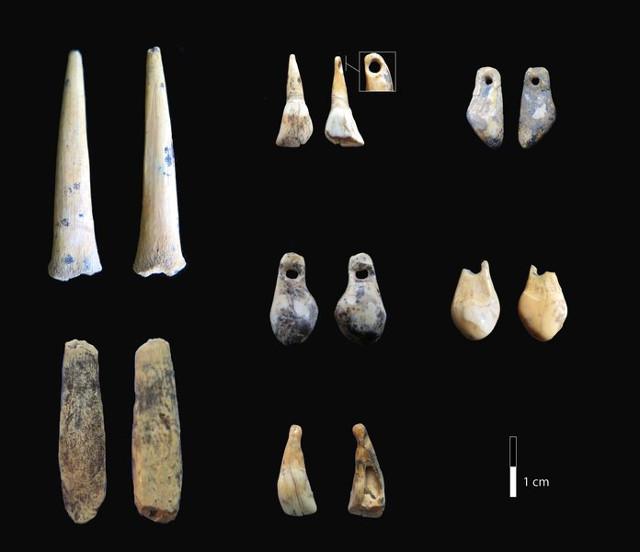
The image (Courtesy Katerina Douka, All Rights Reserved) shows various bone points and teeth found in Denisova Cave’s Upper Paleolithic layers sampled for radiocarbon dating. According to the results, they date back to a period between 49,000 and 43,000 years ago and are therefore the oldest artifacts discovered in northern Eurasia.
Professor Tom Higham of the University of Oxford, part of Dr. Katerina Douka’s team, stated that there’s still an open question about the authors of these artifacts because Homo sapiens might have lived in that area as well. He expressed the hope that further discoveries could clarify the issue.
In essence, there are still many questions, but it’s increasingly clear that at least two species met in Denisova Cave, Neanderthals and Denisovans. Fossils and artifacts aren’t sufficient to understand exactly when only one of the two species lived there and when there were meetings between the two species with various interbreedings but the research continues and will help to better understand also the most complex behaviors of these hominins, who were already capable of creating artifacts that demanded mental skills as high as those of modern humans.
