2020

Sauropod fossil embryo

An article published in the journal “Current Biology” reports the study of a fossil embryo of titanosaur dating back to about 80 million years ago, in the Cretaceous period, that came from Argentina. A team of researchers led by Dr. Martin Kundrat used sophisticated techniques to study it. The egg around it was dissolved by applying very carefully an acid preparation, and at that point, the embryo was scanned at the European Synchrotron Radiation Facility (ESRF) in Grenoble, France, which made it possible to create a three-dimensional reproduction. The examination offers new insight into the development of sauropods, the large group of herbivorous dinosaurs, and particularly their skulls, indicating that at least titanosaurs had stereoscopic vision and a horn like rhinos that was lost in adulthood.

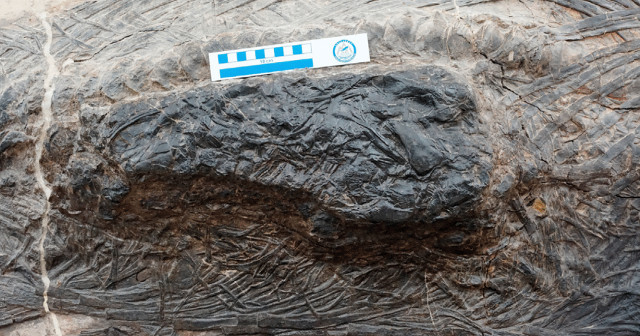
The stomach of the fossil of Guizhouichthyosaurus tangae

An article published in the journal “Science” reports the study of the fossil remains of an ichthyosaur whose almost complete skeleton includes some sort of extras in the form of the fossil remains of another reptile, a thalattosaur of the species Xinpusaurus xingyiensis, in its stomach. A team of researchers examined these fossils discovered in China and dating back to the Triassic period attributing them to a Guizhouichthyosaurus tangae, a species belonging to the group of ichthyosaurs. There are arguments among paleontologists that they could be apex predators in their ecosystems, and the fact that an ichthyosaur devoured an animal as large as a thalattosaur is considered evidence that at least that species was indeed an apex predator.

A Darkling Sea by James L. Cambias

The novel “A Darkling Sea” by James L. Cambias was published for the first time in 2014.

Ilmatar is a moon of a gas giant planet with an ocean of liquid water beneath the thick, frozen surface crust. That ocean is home to complex ecosystems that include a sentient species. A human expedition is on site to study the natives in a collaboration with another alien species, the Sholen, also based on the observation of the natives without getting noticed.

During what’s supposed to be normal scientific activity, Henri Kerlerec, one of the members of the human team, commits an imprudence and loses his life. This starts generating tensions between humans and Sholen with ramifications determined by the presence in both species of factions with different ideas about the policy towards the other species.

Elon Musk and Neuralink's robot surgeon (Image courtesy Neuralink)

In a presentation given yesterday, Elon Musk updated the public on Neuralink’s work on creating an interface between the human brain and computer. In July 2019, the entrepreneur showed a prototype announcing that the company was about to begin testing on humans. Actually, the neural implant was redesigned and tested on pigs, included in the demonstration. Neuralink is working to begin human testing of this new version.

Nuclear Time by Oli Smith

The novel “Nuclear Time” by Oli Smith was published for the first time in 2010.

The Tardis materializes on the outskirts of what appears to be a very normal small town. The Eleventh Doctor, Amy and Rory go to visit it, and quickly realize that the inhabitants are robots except Albert, their creator. The robots use lethal force when discovered, and the travelers must try to hide while Albert gets killed.

A plane approaches the town and the Doctor realizes that it’s about to drop an atomic bomb on the town to destroy the robots. He tries to escape with his companions but loses sight of them. On the other hand, he’s faced with himself and the suggestion of a strategy to prevent everyone from being killed, but the result is a time alteration.