2021

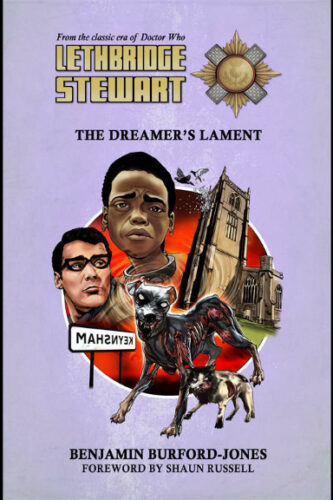
The Dreamer's Lament by Benjamin Burford-Jones

The novel “The Dreamer’s Lament” by Benjamin Burford-Jones was published for the first time in 2017.

For Alistair Lethbridge-Stewart, receiving a phone call offers a chance to interrupt a conversation with his mother about his private life. The fact that reporter Harold Chorley is calling doesn’t make him feel much better, but a missing train might be the kind of case he should investigate. When the two men go to investigate the situation near the village of Keynsham, they end up back in the past, in 1815.

When their commander fails to return to duty at the beginning of the week, Lethbridge-Stewart’s men try to piece together his whereabouts. Anne Travers also gets involved in trying to understand the strange phenomena found in the so-called Keynsham Triangle, where people have been disappearing for a long time. The scientist’s task is made more difficult by the problems related to her family.

Ninefox Gambit by Yoon Ha Lee

The novel “Ninefox Gambit” by Yoon Ha Lee was published for the first time in 2016. It’s the first book in The Machineries of Empire series.

Captain Kel Cheris won a battle against the heretics but is disgraced because she used an unorthodox strategy. In the Hexarchate, everything follows precise rules and their violation can even be considered a betrayal and punished with the inclusion among the condemned during the rituals of torture to death.

Kel Command offers Cheris a chance for redemption by demonstrating her allegiance to the Hexarchate. Cheris’s proposal is to retake the Fortress of Scattered Needles, a space fortress that was conquered by the heretics, using the advice of Shuos Jedao, a general who lived centuries before who never lost a battle. Jedao is considered a traitor whose conscience is kept available, and for Cheris working with him is a very risky task.

A reconstruction of Leti's skull in Professor Berger's hand

Two articles published in the journal “PaleoAnthropology” report as many studies connected to Homo naledi, the species of hominins whose fossils were discovered in the cave called Rising Star about 50 km northwest of Johannesburg, South Africa. One of the two articles reports the study of a partial skull with some teeth belonging to an individual who was still in the growth phase, possibly a child. The other article reports the results of the exploration of the subsystem of the cave called Dinaledi. These studies offer new insights into what Professor Lee Berger, who led the team that conducted the first studies on Homo naledi, called an enigmatic species.

Manseed by Jack Williamson

The novel “Manseed” by Jack Williamson was published for the first time in 1982.

The Defender wakes up confused and doesn’t even recognize his own body, which looks quite human but without genitals. He has various memories of different people that don’t help him understand what’s happening to him and around him. He hears a voice that seems familiar to him since it belongs to Megan Drake but it quickly becomes clear that it’s a reproduction.

The voice that communicates with the Defender is that of a spaceship that was damaged by a meteorite. The Defender must assess the damage and try to repair it in order to resume the mission of finding a habitable planet where humans based on samples chosen on Earth many millennia earlier can be born and grow up.

The Bodo 1 skull (Image courtesy Jeffrey H. Schwartz / Roksandic et al.)

An article published in the journal “Evolutionary Anthropology” reports a research on hominins of the Middle Pleistocene period that proposes the species Homo bodoensis as a classification for a series of hominin fossils discovered in Africa and some discovered in some areas of Europe. A team of researchers led by paleoanthropologist Mirjana Roksandic of the University of Winnipeg, Canada, reached this conclusion after reassessing fossils discovered over the years in Africa and Eurasia. A consequence of this proposal is the elimination of the species Homo heidelbergensis and Homo rhodesiensis with their often inconsistent definitions. A series of fossils attributed to the species Homo heidelbergensis would be Neanderthals.