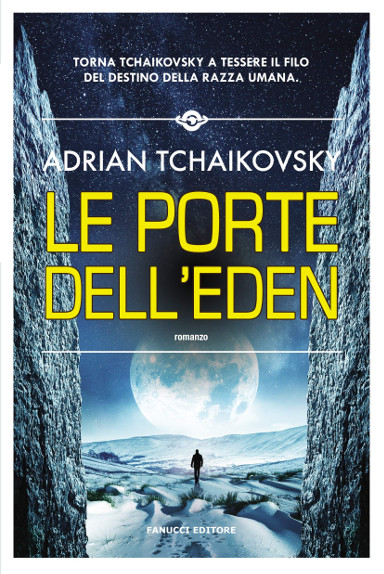
The novel “The Doors of Eden” by Adrian Tchaikovsky was published for the first time in 2020.
Lee and Mal are very different from each other and yet they become inseparable friends and start investigating together on sightings of creatures that are out of the ordinary. They usually have to put a lot of imagination into writing comments that support the alleged sightings but one day an investigation leads to something all too real and Mal vanishes. Four years later, Lee thinks she lost her when Mal calls her to arrange a meeting.
Dr. Kay Amal Khan is working on some research in physics that is supposed to be very theoretical but someone seems interested in it the wrong way. The woman works for the government and the issue involves national security, so Julian Sabreur of MI5 has to protect her. His investigation quickly becomes complicated because among his suspects is one person who doesn’t look entirely human and another who is believed to be dead. Soon, the developments indicate that there are parallel Earths and there are various forces at work with unknown agendas.
Adrian Tchaikovsky has written novels in the past in which he already imagined non-human intelligences with intriguing scientific speculations used to develop interesting stories. “The Doors of Eden” exploits that kind of idea by applying it to a multiverse where there are parallel Earths where evolution followed very different paths. These are Earths on which sentient species very different from humans emerged and this also means ways of thinking and societies very different from the human ones.
The author uses excerpts from the fictional essay “Other Edens: Speculative Evolution and Intelligence” by Professor Ruth Emerson of the University of California to describe the evolutionary path of life on different Earths. These excerpts open the various parts of the novel allowing readers to understand which sentient beings emerged in the various parallel Earths. To be pedantic, these excerpts break the action but I found them very intriguing because they present alternate stories of the Earth that can be radically different.
The divergences occur in different geological eras with the consequence that sentient species emerge in species that belong to different phyla in the taxonomic classification. Adrian Tchaikovsky’s speculations are interesting also because the various sentient species face very different environmental situations with diverse consequences on the history of their Earth.
The interactions between beings originating from various Earths lead to a complex plot in which different agendas and different motivations sometimes combine and at other times clash. Adrian Tchaikovsky followed the point of view of various human characters who slowly reveal the various pieces of a puzzle that spans multiple universes. Not all the characters seemed successful and in my opinion, if there’s a flaw in the novel it’s what seemed to me like a cardboard villain.
The human characters are often used to show reactions to encounters with non-human beings from other Earths. Some non-human characters are more refined and are useful to offer points of view that can be radically different from human ones. In some cases, the difficulty of communication between extremely different species is central to the plot.
In my opinion, the small flaws take little away from “The Doors of Eden” and overall, Adrian Tchaikovsky makes good use of the idea of parallel Earths to create a terrific mix of scientific speculation and a plot with lots of action and twists. It’s a novel that requires some attention to follow a complex story but if you are willing to make this effort, I recommend reading it.
