
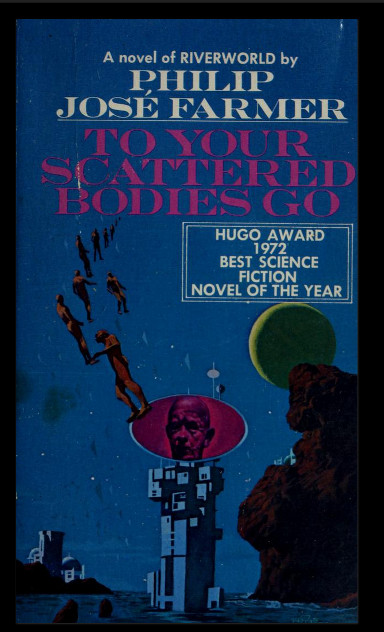
The novel “To Your Scattered Bodies Go” by Philip J. Farmer was published for the first time between 1965 and 1966 in the magazine “Worlds of Tomorrow” and in 1971 as a book. It won the Hugo Award for Best Novel of the Year. It’s the first book in the Riverworld series.
Sir Richard Francis Burton dies in 1890 but wakes up in an unknown place where he finds himself surrounded by other people who, just like him, are naked and totally hairless but he seems to be the only one awake. He’s trying to figure out what’s going on when everyone is thrown into a valley next to a river.
The people in the valley include an alien from the Tau Ceti system who arrived on Earth in the early 21st century and a Neanderthal. Everyone says they died and found themselves there. On the riverside, there seem to be people everywhere, who could have created such an environment and resurrected all the sentient beings that ever existed on Earth?
Creating “To Your Scattered Bodies Go” was complicated. In 1952, Philip J. Farmer wrote a novel he titled “Owe for the Flesh” which he submitted to a writing contest, which he won. However, the publisher requested a number of changes and subsequently failed without paying Farmer the prize. For the author, this was a major blow, as it would’ve helped him become a full-time professional writer.
It took over a decade for Philip J. Farmer to take his unpublished novel and turn it into “To Your Scattered Bodies Go”, which was published first in “Worlds of Tomorrow magazine” in the form of two novellas and then as a book in an edition that won the Hugo Award for Best Novel of the Year.
The basic idea is truly colossal, as the novel begins with the resurrection of all the sentient beings that have ever lived on Earth, including hominins other than Homo sapiens and aliens that arrived on Earth in the early 21st century. The story follows explorer Richard Burton’s point of view starting with his death, followed by his awakening in the new world. His exploration of that mysterious world and his river lead him and other people with whom he has formed a group to great adventures that also aim to try to understand what is behind that colossal creation.
The adventurous component of the novel is evocative due to the vast scale of the setting and the presence of all humanity, but it’s only part of the story. Precisely because all human beings have resurrected in this new world, the existing human dynamics on Earth very quickly begin to be repeated, for better or for worse.
The epic exploration of the river and its banks by the protagonists, which include historical figures, is intertwined with moments of introspection and reflection, especially by Richard Burton. His thoughts and his conversations, also with writer Peter Jairus Frigate, who is a sort of alter ego of the author, concern many aspects of humanity, both positive and negative. At the beginning of the novel, they concern in particular the reactions of people who wake up in a place that is very different from their conception of the afterlife. Later, they tend to be more about behaviors related to the social structures that emerge.
Richard Burton tries to find out who could have created a colossal environment like the River and the territories on its banks and recreated all the sentient beings who lived on Earth. He finds some answers but “To Your Scattered Bodies Go” ends with some unanswered questions. It’s a novel that in my opinion, is extraordinary and a must-have in the collection of any science fiction fan but you must keep in mind that it has an ending that is in some ways open.
