
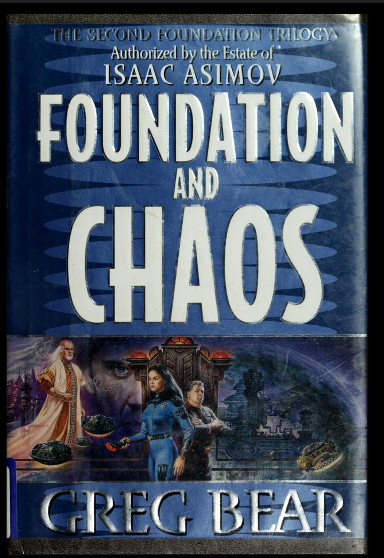
The novel “Foundation and Chaos” by Greg Bear was published for the first time in 1998. It’s the second book of the so-called second Foundation trilogy and follows “Foundation’s Fear“.
Hari Seldon devoted his life to psychohistory but he has made many enemies and predicting the end of the Galactic Empire doesn’t help his reputation. For this reason, he must defend himself against a charge of high treason and be judged by Linge Chen, who holds the real power.
R. Daneel Olivaw is working with a group of robots to guide humanity through the transition period that will begin after the inevitable end of the Galactic Empire. During a trip to space, the robot that uses the human identity of Lodovic Trema undergoes a change that leads him to reevaluate all of his work.
Klia is a girl with remarkable psychic powers who finds herself in a complicated situation that seems to worsen day by day as she seems to become the object of interest of dangerous people. Forced to accept help from a mysterious group, she ends up involved in a power struggle she doesn’t understand.
“Foundation and Chaos” continues the so-called second Foundation trilogy in which various parts of the future history told by Isaac Asimov are greatly expanded. A sort of retelling of many events is made in light of the work that Asimov had begun in the last years of his life. In particular, the authors of this trilogy include the presence of robots, starting with R. Daneel Olivaw.
Greg Bear essentially rewrites the short story that Isaac Asimov added to the original ones in 1951 to collect them in what became the first book of the original Foundation trilogy. “Foundation and Chaos” takes place decades after “Foundation’s Fear” but uses several elements introduced by Gregory Benford to greatly expand on the original story. This means that you still need to be familiar with the various parts of Asimov’s future history and it’s better to have read Benford’s novel as well, for example, to understand the parts that include simulations of Voltaire and Joan of Arc.
The original story is Gaal Dornick’s account of the events concerning Hari Seldon, of which he has limited knowledge of the trial and its aftermath. In the new novel, at times, the father of psychohistory almost seems like a marginal character in a much broader story in which different ideas about the future of humanity collide.
Robots seem more prominent than ever in “Foundation and Chaos,” where R. Daneel Olivaw’s plans to lead humanity are central to the plot. They find opposition from some humans who suspect the existence of what most of the population consider ancient myths but also from a faction of robots. Greg Bear digs into the heart of the events that lead to the birth of the two Foundations and in my opinion manages to respect the original story by Isaac Asimov and at the same time tell everything that can be considered “behind the scenes” with regards to the treason trial faced by Hari Seldon.
I found “Foundation and Chaos” better structured than “Foundation’s Fear” in the sense that the events are tied more directly to Hari Seldon’s personal story. At the same time, I got the impression that Gregory Benford wrote a very long novel to include parts to be taken up and further developed by his colleagues. I still have my doubts about the presence of the simulations of Voltaire and Joan of Arc because I find that they have weighed down a story that has already become complex.
Overall, “Foundation and Chaos” seemed to me a good novel that may appeal to readers who appreciated Isaac Asimov’s efforts to piece together all the parts of his future history but don’t expect Greg Bear to imitate his style.
