
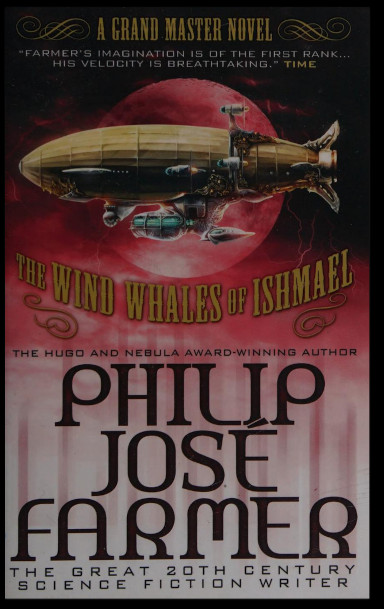
The novel “The Wind Whales of Ishmael” by Philip J. Farmer was published for the first time in 1971.
Ishmael is the only survivor of the whaler Pequod but fate seems to mock him because he gets sucked into a space-time crack that takes him to a place that seems totally alien to him. There are humans while the oceans seem to have vanished, resulting in ships and animals floating in the air.
The red sun is one of the clues that Ishmael ended up in the distant future. He meets Namalee, a woman who is herself a castaway and teaches him her people’s language and customs. He discovers that the few humans still living on Earth are divided into cities at war with each other. He ends up involved in an adventure full of dangers of various kinds to help Namalee recover the sacred idols stolen from her city.
Over the course of his career, Philip J. Farmer wrote many stories connected to the works of other authors and often included even historical figures in his original works. “The Wind Whales of Ishmael” is an unofficial sequel to Herman Melville’s “Moby Dick” set in the distant future. I’ve never read “Moby Dick” and I didn’t feel like I was missing anything important while reading “The Wind Whales of Ishmael” but it’s possible that I missed some references to Melville’s novel.
Farmer’s story of Ishmael picks up where Melville left off. The luck of being rescued after being the only survivor of the Pequod doesn’t last long for Ishmael, who is projected into a very distant future where the Earth has changed dramatically.
The planet described by Farmer is barely habitable and the humans who still live there are barely surviving. Despite this, it seems that the cities in which they live still find resources to wage war on each other. For this reason, Ishmael finds himself in the middle of a complicated situation, also because plants and animals existing in that future can be very dangerous.
The tone of the novel seems at times almost fantasy with airships chasing flying animals. Due to the scarcity of resources, the technological level is not much different from that of Ishmael’s time. Also for this reason, the aerial setting and the development of the plot are more similar to a fantasy story than a science fiction one. Mind you, it doesn’t include magic or other supernatural elements that we can expect in fantasy stories but the peculiar setting can give it that flavor.
The author imagines future whalers whose crews work in many ways like the ones known to Ishmael to kill flying whales. The novel may be unpleasant for readers who hate the concept of whaling although it’s unclear whether future whales have intelligence comparable to that of today’s whales.
Ishmael seems to adapt really well to that world which in many ways is alien to him. That also includes understanding the various religious beliefs of the humans of that future. Religion is a theme included in many of Philip J. Farmer’s works and in “The Wind Whales of Ishmael” it’s important but the novel is above all a great adventure in a setting that is really exotic.
“The Wind Whales of Ishmael” is an imperfect novel I would never include among Philip J. Farmer’s best. The pace is uneven and the development of the characters is limited but the setting and the connection with “Moby Dick” make it one of the most peculiar novels by this author. It’s short by today’s standards and also for this reason, if you appreciate adventurous stories, you might like it.
