
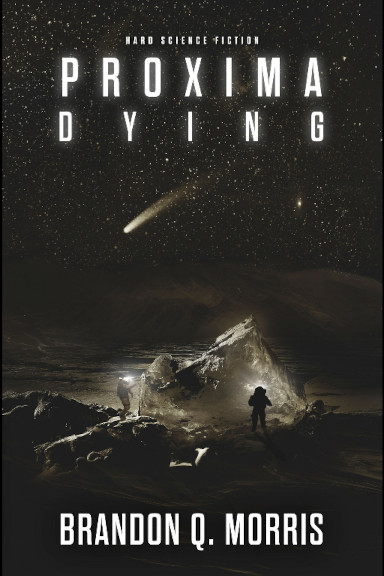
The novel “Proxima Dying” by Brandon Q. Morris was published for the first time in 2021. It’s the second book in the Proxima Trilogy and follows “Proxima Rising”. The English translation is by Frank Dietz.
Marchenko is using a robotic body to host him to be able to accompany Adam and Eve in their exploration of the planet Proxima b in search of the natives who sent a signal into space. It’s certainly not an easy mission, especially after what they discovered.
On the planet’s side, the one always illuminated by its star, there seems to be no trace of sentient inhabitants. The travelers decide to move the search to the night side with the difficulties that this brings, starting with the perpetual darkness and the ice that covers that hemisphere.
“Proxima Dying” continues the trilogy written by physicist Matthias Matting, who uses the pen name Brandon Q. Morris, focused on the mission to the Proxima Centauri system. It’s a mission designed following the detection of a distress call from a planet in that system, Proxima b. The trilogy is a single story split into three books so you need to read them all.
Brandon Q. Morris’s novels are labeled by himself as hard science fiction, so it’s certainly not surprising that the author attempted to realistically imagine the situation on Proxima b. This is a real exoplanet and the information available about it is used to develop speculation about possible life forms that may have evolved in that environment.
The descriptions are long and detailed because the environment is in a certain sense one of the protagonists of the trilogy. They slow down the pace of the narrative along with Marchenko’s monologues. There are many events and the travellers’ adventure is certainly not simple but the narrative choices confirm how the events are often functional to the descriptions of what the protagonists find. In some cases, they have to make important decisions about what to do and this involves discussions. They too are used to develop the scientific element and the speculations connected to them.
Adam and Eve’s behaviors seem even too functional to the plot’s dramatic developments. They were literally created for that mission and their entire lives up until arriving on Proxima b were about preparing for that mission. Despite this, they often seem unprepared, with the consequence that some of their decisions only create problems.
The result is that there are certainly several descriptions of the possible geological and environmental characteristics of the planet Proxima b and of the natives’ artifacts but in my opinion, the plot sometimes suffers as a result. In some cases, some story developments really seem like an excuse to include some descriptions that are intriguing but sometimes included in a somewhat forced way.
Among the features of Brandon Q. Morris’ novels is the inclusion of appendices that cover scientific topics significant to the plots for educational purposes. The appendice of “Proxima Dying” concerns dark matter, one of the cosmological mysteries currently at the center of important studies and discussions regarding its existence and nature.
Like the first book, “Proxima Dying” has no real ending because it’s the second part of a larger story, so it makes sense to read it if you’re ready to read the whole trilogy. It’s explicitly labeled as hard science fiction, so I recommend it to readers who appreciate this subgenre and can be stimulated by all the speculations present in the novel. It’s available on Amazon USA, UK, and Canada.
