
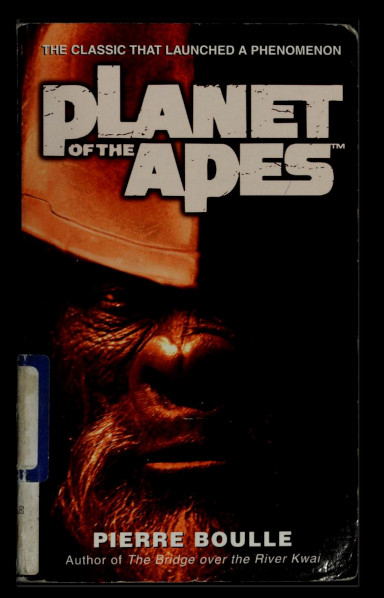
The novel “Planet of the Apes”, also known as “Monkey Planet” (“La Planète des Singes”), by Pierre Boulle was published for the first time in 1963. It was translated into English by Xan Fielding.
Jinn and Phyllis are spending a vacation in space when they come across a message in a bottle abandoned in space. It contains a manuscript in which the journalist Ulisse Mérou tells his incredible story.
Ulisse Mérou was invited by Professor Antelle to be part of a scientific expedition in the system of the star Betelgeuse. There, the space explorers found a planet very similar to Earth and landed there with a small spacecraft. The surprise of finding beings completely similar to humans was surpassed only by the discovery that the rulers of the planet are sentient apes.
“Planet of the Apes” is best remembered for the film adaptation, which started a series of films with new adaptations produced over the following decades. The first film is memorable, among other things, for the final twist, which comes from a development of the story that takes only the basic concepts of the novel.
Pierre Boulle developed a story with the literary mechanism of the message in a bottle, a manuscript in which Ulysses Mérou recounts the contact with a civilization of intelligent apes on a planet that orbits the star Betelgeuse. The protagonist and his companions are treated like animals by the apes of the planet, a situation that reverses the one existing on Earth.
Ulisse Mérou’s attempts to understand how the apes’ society developed and why humans on the planet have remained intellectually at an animal level are used to offer various reflections. Initially, he must try to understand the basis of that situation, but later ends up involved in the scientific research underway on the planet.
Pierre Boulle includes pseudo-scientific considerations that are sometimes very speculative. For example, the ones on the possibilities of having an organized society by imitating certain behaviors of a sentient species, not by chance using the term aping, are far-fetched. They’re used in reflections on the stagnation of a civilization, which can still be interesting. In essence, these parts should be taken with a pinch of salt: after all, it’s a novel set on a planet that orbits a red supergiant star, that is, a star in its death throes, and yet it has remained habitable.
In the end, in my opinion, the best parts are those in which the protagonist sees in sentient apes the merits and flaws of Earth’s humans. In some ways, the story is a satire of a certain kind of human, with their prejudices and arrogance.

In the situation in which he ends up, Ulysses Mérou struggles to maintain his rationality, and sometimes, ends up behaving in purely instinctive ways like the local humans. This is also true, and perhaps especially, in his relationships with the local woman he calls Nova. Despite this, he tends to feel superior to them, and sometimes even to some apes, in attitudes that reflect forms of racism seen on Earth.
This novel is short by today’s standards, and this means that the pace tends to be fast, thanks to the many events narrated despite the abundance of reflections made through the protagonist. Ulysses Mérou finds continuous surprises, and the ending is a notable twist, even if totally different from that of the first film.
“Planet of the Apes” has some flaws, but in my opinion, it’s still interesting in certain reflections on humanity. It should be read trying not to think about the film adaptations it started. It’s available on Amazon USA, UK, and Canada.
