
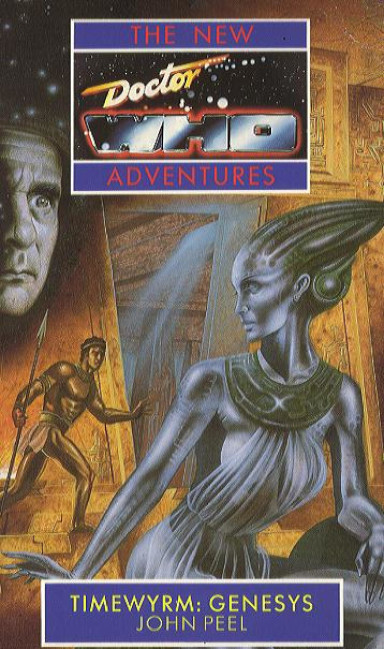
The novel “Timewyrm: Genesys” by John Peel was published for the first time in 1991. It’s No. 1 in the “New Adventures” range by Virgin Publishing.
The Seventh Doctor is trying to sort out his memories, but accidentally erases Ace’s. He manages to fix them, more or less, but during the operation, he triggers a message from the Fourth Doctor, who mentions a mythical creature known as the Timewyrm. After the Doctor finishes restoring Ace’s memories, the TARDIS lands in ancient Mesopotamia.
A clash between two spaceships causes damage to both. A woman with cybernetic implants manages to land near the city of Kish. Gilgamesh, the king of Uruk, is trying to spy on his rivals in Kish, and the woman tells him she’s the goddess Ishtar and seeks his help. Gilgamesh refuses, and she vows to take revenge on him by exploiting the inhabitants of Kish and their devotion to Ishtar.
“Timewyrm: Genesys” inaugurates Virgin Publishing’s series chronicling the Doctor’s adventures in a sort of continuation of the classic “Doctor Who” series, beginning a couple of years after its cancellation. This novel is used to reprise the protagonists’ stories and launch them into new adventures. John Peel does so by beginning with their memories to offer information that can be useful to refresh readers’ memories, and then including numerous references to the classic series.
The classic “Doctor Who” series’ last season included elements from various myths and legends, and John Peel does the same in this novel, using elements from the Epic of Gilgamesh. In his loose interpretation of this myth, Gilgamesh has superhuman strength but little intelligence and is essentially obsessed with sex. His friend Enkidu is literally a Neanderthal, depicted in the ape-man style that has now been superseded by science.
One of the ideas behind the production of these new literary adventures was to include themes suitable for a more adult audience than those seen on television. In this novel, this includes sometimes gruesome descriptions of killings that occur in fights and explicit mentions of the sacred prostitution that was a significant part of the activities of the Temple of Ishtar. En-Gula, one of the novel’s main characters, is one of the priestesses and is 13 years old. This is an element of a story set a few millennia ago in a civilization with a moral that may baffle the modern reader. You’ve been warned.
For a novel full of references to the classic “Doctor Who” series, I have to say that I found the portrayal of the protagonists quite imperfect. The relationship between the Doctor and Ace seems to be at a level of conflict that was more typical of the early days of their traveling together. The Seventh Doctor’s manipulations maintained a certain level of friction between him and Ace, but over time, a bond developed between the two of them that I would have liked to see much more of in this novel.
In the end, the characters seem written mainly for their use in the plot. This also means that the fake Ishtar is a rather flat villain, obsessed with immortality and determined to achieve it at all costs. Nothing else. No nuance.
In the end, “Timewyrm: Genesys” is a novel that uses various elements typical of “Doctor Who” stories to launch the Virgin Publishing range. It has some flaws, but for fans of the classic series, at the time, it was a way to get some new stories that continued the ones they watched on television. It’s the first book in the Timewyrm mini-series, and today, it might be of interest to fans curious about those stories. You might still find a copy on Amazon USA, UK, and Canada.
