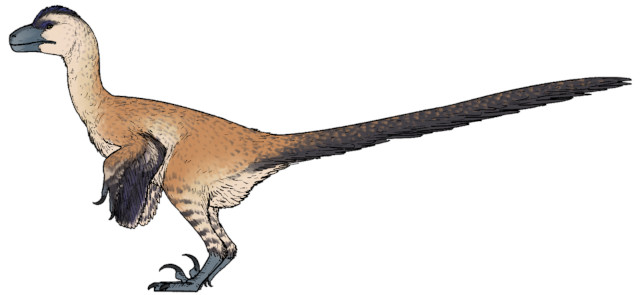
An article published in the journal “Historical Biology” reports the identification of a feathered dinosaur species with bird-like features and particularly strong hands. A team of researchers named it Shri rapax after examining a very well-preserved fossil, albeit missing its head. This fossil has a peculiar history, as it was found in the Gobi Desert in Mongolia during an illegal excavation and later smuggled abroad. This makes it more difficult to study a carnivorous species that lived approximately 71 million years ago and is related to the famous Velociraptor, as both are members of the Dromaeosauridae family.
The top image (Courtesy Léa Moutrille et al / Historical Biology) shows the Shri rapax fossil. The arrow points to the femur reconstructed using elements from both femurs.
The Shri rapax specimen studied was similar in size to a turkey and was a predator. The fossil’s history is unclear due to the circumstances that led to its passing through various hands over the years. It was discovered before 2010 and originally included the head. In 2016, the head and first four cervical vertebrae were separated for a CT scan in Belgium and then returned to their owner. As a result, their traces were lost. The remainder of the fossil was eventually returned to Mongolia and subjected to official scientific study.
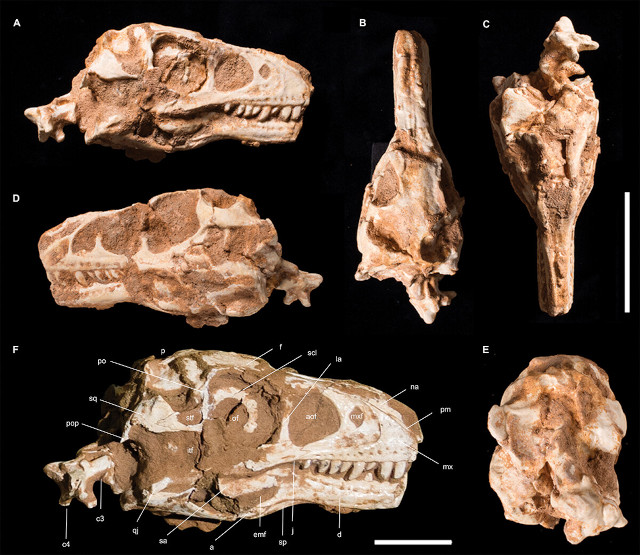
The image below (Léa Moutrille et al / Historical Biology) shows a cast of the Shri rapax’s head, produced based on the 2016 CT scan.
In 2021, the species Shri devi was described, based on a partial skeleton also discovered in the Gobi Desert. The species Shri rapax was assigned to the same genus, recognizing the remarkable similarities between the two species. A phylogenetic analysis used by researchers suggests that the genus Shri was closely related to the species Velociraptor mongoliensis. These species are all assigned to the Velociraptorines (Velociraptorinae), a subfamily of dromaeosaurids.
The hands of Shri rapax are its most distinctive feature due to their strength, superior to that of other known dromaeosaurids. The researchers believe these hands evolved to enhance this dinosaur’s hunting capabilities. This species also had robust jaws, allowing it to kill relatively large prey such as Protoceratops or still-growing ankylosaurs.
The Shri rapax prey theory would explain the diversity of dromaeosaurids present in the Gobi Desert in the late Mesozoic. In essence, it’s possible that this dinosaur’s diet differed from that of Velociraptor mongoliensis. Both were predators, but rather specialized, which reduced or even eliminated competition between them, allowing them to coexist. For this reason, despite the uncertainties surrounding the fossil’s origin, its study is useful for gaining insight into the ecosystem that existed in that area toward the end of the Cretaceous period, the last before the great dinosaur extinction.
The bottom image (Courtesy Connor Ashbridge, Creative Commons Attribution 4.0 International) shows an artist’s reconstruction of Shri rapax.