
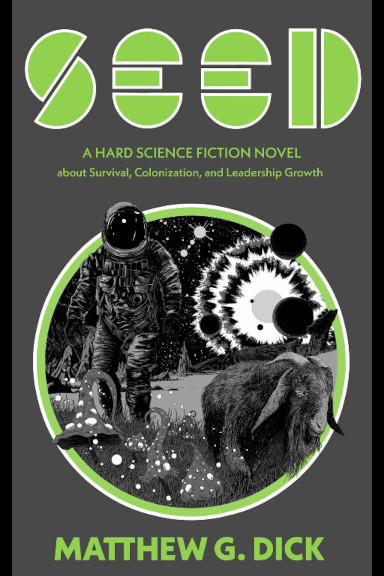
The novel “SEED” by Matthew G. Dick was published for the first time in 2020.
Nick Burke participates in a mission to Mars that aims to create a self-sustaining colony. This is the third attempt, but it’s fraught with problems that lead to its failure, exactly like the previous ones. The astronauts return to Earth, and Nick realizes that the path to colonization could be very different.
His father had involved Nick in an experiment to create a digital clone since his birth. When he manages to secure funding from billionaires in exchange for transporting embryos of their children or clones, Nick’s digital clone is loaded into a robotic body and launched to another star system. That project isn’t without its challenges.
The idea of an interstellar expedition carrying only the bare minimum necessary to allow humans and Earth’s animals to be born on another planet is not new. From Jack Williamson’s “Manseed” to Brandon Q. Morris’s recent Proxima series, this idea has been developed in various ways.
Matthew G. Dick developed this concept with a first-person narrative from the perspective of protagonist Nick Burke. Initially, the narrative focuses on the flesh-and-blood original, then shifts to his digital clone in a robotic body, who narrates the development of a colony on a habitable exoplanet.
Unlike previous stories based on the same idea, the “SEED” expedition is developed in a manner typical of this period: with private funding. In this case, money was raised primarily by titillating the ego of some billionaires with the prospect of a colony full of their descendants.
Nick Burke is an astronaut who participated in an expedition to Mars, so his choice to lead the creation of a colony in another star system makes sense. However, it sometimes seems as if he hasn’t received any training in raising children and animals.
When the spaceship carrying the supplies needed to create a colony reaches its destination, Nick Burke must often rely on an artificial intelligence, which acts as his assistant. However, he’s the one who must physically do all the work required to run the colony, as the AI is installed in a “normal” computer.
After the children are born, Nick is the one who must handle their feelings and emotions, and that highlights his flaws and the AI’s limitations. Nick is far from perfect as a person, so he makes mistakes. His attempts to correct his mistakes and avoid repeating them are an important part of the plot, especially since he’s the only role model for the newborns, and his behavior has a huge influence on the colony.
The novel’s subtitle is “A Hard Science Fiction Novel about Survival, Colonization, and Leadership Growth,” but in the end, the human factor seems to prevail, as the most technical and scientific aspects are limited. The author focuses on certain periods of the colony’s development while ignoring others, sometimes with significant leaps forward in time. For this reason, some readers may be satisfied while others may be disappointed, depending on what they’re looking for in a story of this type.
The tone alternates between moments of crisis and more light-hearted, sometimes even comical, moments. Nick Burke brought a remarkable musical repertoire (it’s no coincidence that one of the colonists is named Lemmy!), which ends up becoming an important part of life in the colony. It’s as if the novel had its own soundtrack.
Overall, I found “SEED” enjoyable despite the unoriginal theme for the development often focused on the protagonist’s personal journey. One could say it’s a novel suitable for fans of science fiction and rock-and-roll. It’s available on Amazon USA, UK, and Canada.
