
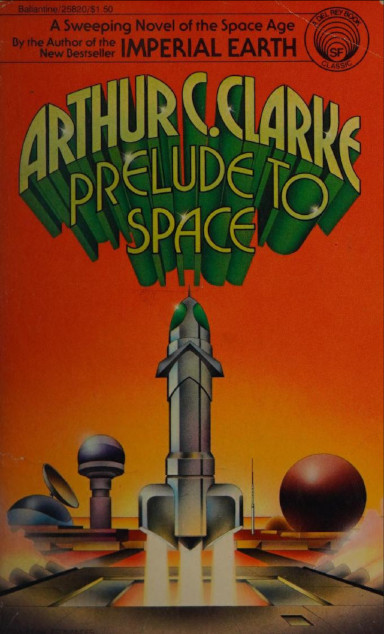
The novel “Prelude to Space”, occasionally published as “Master of Space” or “The Space Dreamers”, by Arthur C. Clarke was published for the first time in 1951.
Preparations for the launch of the Prometheus mission have begun. This is a historic moment because it will be the first mission to land astronauts on the Moon, so historian Dirk Alexson is tasked with watching the events and gathering testimonies from the people working on it.
One of Dirk Alexson’s goals is to recount what scientists and engineers working on the project told him in a way that ordinary people can understand. To provide the full story, he follows the various phases of the project, first in England and then in Australia, where the launch will take place.
“Prelude to Space” was published well before the start of the Apollo program, and in 1976, Arthur C. Clarke wrote a preface to a new edition of the novel, commenting on the differences between the project described in his novel and the actual Moon missions conducted in the 1960s and 1970s. The author admits that he also intended to publicize space travel by offering a realistic vision, far different from that generally portrayed in science fiction stories of the time.
Arthur C. Clarke had a profound technical and scientific background, and this is evident in his descriptions of the technologies employed in the novel for the Prometheus mission. When he wrote the novel, there were various ideas about the possible development of real spacecraft, and Clarke focused on the ones that, at the time, seemed most plausible to him.
The centrality of England in the development of the mission is also a factor linked to the era in which “Prelude to Space” was written, and not just to Arthur C. Clarke’s nationality. The USA didn’t seriously develop its space program until many years later, after the Soviets launched Sputnik and, more importantly, began human spaceflight.
The novel’s educational intent is clear from the beginning. The idea of having a historian document the launch preparations leads to a description of the technologies used in the Prometheus mission. Typically, science fiction stories of the time about space missions focused on the actual flight, but “Prelude to Space” focuses almost exclusively on the preparations.
The characters are also mostly functional to the descriptions of the preparations for the Prometheus mission. This means that few of them have any real development, and most serve only to recount certain aspects of the mission. The plot can be said to be rather loose, in the sense that it’s made more of conversations than events.
Beyond the technical and scientific aspects, there’s an underlying optimism regarding space travel throughout the novel. Nationalism is criticized in different occasions, with statements about the absence of borders in space. Unfortunately, from this perspective, the collaborations and statements of astronauts who saw a single, borderless world have clashed, and continue to clash, with the tribalisms that exist on the ground.
In reality, technological developments have been quite different from the ones Arthur C. Clarke envisioned, and at much higher costs than those mentioned in the novel. It’s almost paradoxical that the developments the author most accurately predicted are secondary in the novel and concern geostationary satellites.
In the descriptions of space missions, technological developments have followed quite different paths and at different timelines compared to those described in the novel. Reusable launch vehicles have only been developed in recent years and are still the exception, not the rule.
The pioneering spirit that permeates “Prelude to Space” hasn’t yet been completely overcome, even if the commercial element is now becoming increasingly relevant. Arthur C. Clarke’s optimism clashes with tribalism and objective technological difficulties. This makes this novel in some ways outdated, but in others still science fiction, with reflections that are still relevant on collaboration for common goals. It’s above all for these elements that this novel still makes sense to read. You can find it on Amazon USA, UK, and Canada.
