
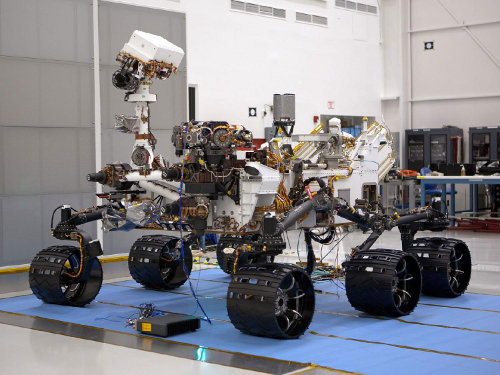
The Mars Rover Curiosity will reach Mars in six months but is already working. In fact, its job isn’t only to go to Mars to study it more thoroughly than the previous spacecrafts but also to give us an idea of what dangers astronauts will face in the future if at last there will be a space mission to take humans to Mars or anyway in deep space.
The Mars Rover Curiosity hasn’t the slightest physical resemblance to a human being however it’s traveling in a spaceship and just like astronauts would and that means that it gets hit by radiation just as it would happen to a human crew.
On January 27, 2012, the spacecraft the Mars Rover Curiosity is traveling in was hit by the most intense solar storm since 2005 following a solar flare of considerable intensity. An enormous amount of protons and electrons were fired from the Sun almost directly in the direction of Curiosity.
Unlike previous Mars Rovers, Curiosity was equipped with a Radiation Assessment Detector (RAD), an instrument that measures cosmic rays, neutrons, protons and other particles that can cause dangers to biological creatures.
The RAD has the primary purpose of measuring the various types of radiation on Mars surface but it was already turned on during its journey so that it could measure levels of radiation that hit it in space.
[ad name=”AmazonDocumentary”]
Scientists already have a fairly good idea of the outside radiation levelsbut now Curiosity is providing data on the levels inside a spaceship. This information is difficult to obtain via simulations even with modern supercomputers such as Pleiades, that NASA one which is among the most powerful in the world. This is due to the fact that interactions between the energy charged particles from the Sun and the materials that form the spaceship are very complex. The data collected by Curiosity will also be important to try to create reliable simulations.
The Mars Rover Curiosity is bombarded by cosmic rays even when the Sun is quiet because the cosmos is full of radiation coming from perhaps thousands of light years away, originate from very distant blacks holes and supernovae. Of course, on January 27 the amount of radiation detected was many times higher than normal.
Scientists are now analyzing the data transmitted from the Mars Rover Curiosity to see what level of protection it’s been given by the spacecraft during the solar storm. Curiosity is traveling to Mars but it could have already provided us with valuable information for possible future space missions bringing astronauts beyond the Moon.

Permalink