
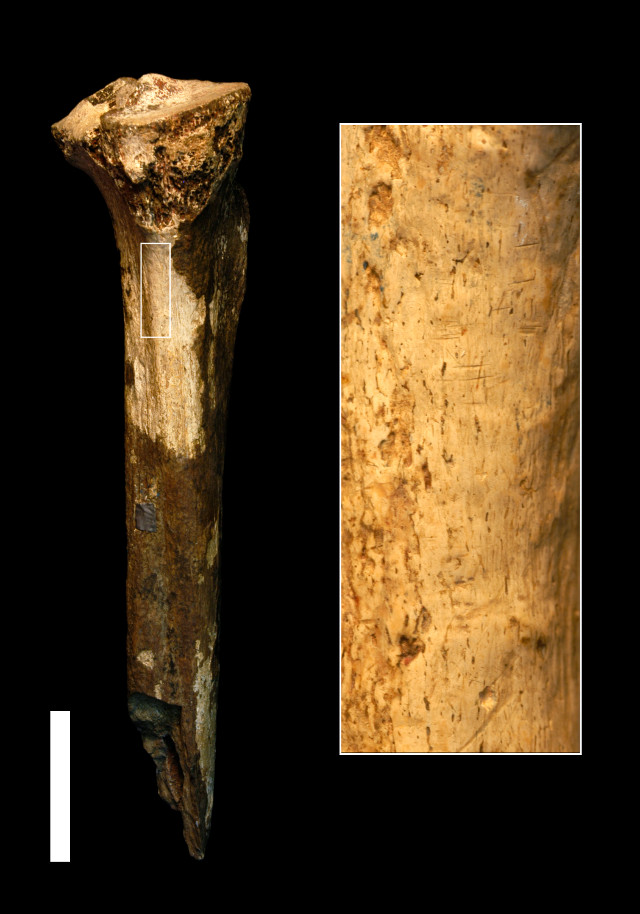
An article published in the journal “Scientific Reports” offers evidence that hominins who lived at least 1.45 million years ago killed each other and possibly practiced cannibalism. Paleoanthropologist Briana Pobiner of the National Museum of Natural History led the study of the markings found on a fossil tibia discovered in northern Kenya. The examination of 3D models of the surface of this tibia indicates that 11 of those marks were left by stone tools and that their characteristics likely indicate butcher work much like that seen on fossil animal bones slaughtered by hominins for consumption.
It’s not certain that the slaughtered individual belonged to the same species as the one or ones who killed him since at the time, different hominin species could have lived in the same area. This means that it may not be a case of cannibalism but it seems likely that those hominins killed each other.
Ancient Homo sapiens or hominin bones showing signs of butchering and indicating a practice of cannibalism were found on various occasions. The case that may be the oldest was also the most controversial given that a skull discovered in South Africa had uncertain datings, between 1.5 and 2.6 million years, and discussions about the origins of the cuts found on it.
Paleoanthropologist Briana Pobiner discovered an ancient fossil tibia in the National Museum in Nairobi, Kenya, during a search for possible predators hunting the ancestors of modern humans. She began an examination of the tibia cataloged as KNM-ER 741 but found signs that seemed to her evidence of slaughter.
In order to conduct more thorough examinations, Briana Pobiner created molds of the cuts and sent them to Michael Pante of Colorado State University without giving him details so as not to influence the anthropologist’s opinion. Pante created 3D scans of the molds and compared the cuts to the shape of teeth marks and tool cuts in a large database.
The result is that 11 marks match the type of damage inflicted by stone tools. 2 other marks were probably left by the teeth of a large cat, possibly a saber-toothed species that existed at the time and tried to feed on the last useful remains left on the bone.
The similarities of the cuts on the tibia examined with those found on the bones of animals that were slaughtered for food suggest that that individual was also killed for food. In the case of a ritual, the traces on the bones tend to be different, for example, without the extraction of the marrow.
This doesn’t offer enough evidence of cannibalism because it’s by no means certain that the victim was killed by one or more individuals of the same species. The possible presence of different hominin species in today’s Kenya at that time had already made it difficult to attribute the tibia cataloged as KNM-ER 741: initially, it was attributed to an Australopithecus boisei but after about twenty years a new study attributed it to a Homo erectus based on a comparison with the individual nicknamed the Turkana boy. This individual whose skeleton was discovered in today’s Kenya, near Lake Turkana, had a complex attribution as well because some paleontologists/paleoanthropologists consider him a Homo ergaster.
Despite the advances in paleoanthropology obtained with the discovery of many fossils in recent decades and with new examination techniques, the attribution of an isolated bone can still be difficult. The scarcity of hominin tibias makes the taxonomy of the fossil KNM-ER 741 uncertain, so the authors of this study generically referred to that individual as a hominin.
If there are no disputes on the attribution of the cuts to a butchering technique or the interpretation of the intentions of the perpetrator of that slaughter, it will be the oldest case now known of hominins killing each other for food.
Briana Pobiner expressed her interest in conducting a new study of the skull discovered in South Africa using the same methodology used to study the KNM-ER 741 tibia. The paleoanthropologist also stressed the fact that it’s possible to make amazing discoveries by re-examining fossils that have been part of museum collections for a long time. Indeed, new investigative techniques help fossil analyzes and the quick and widespread circulation of studies improves the quality of discussions.
