
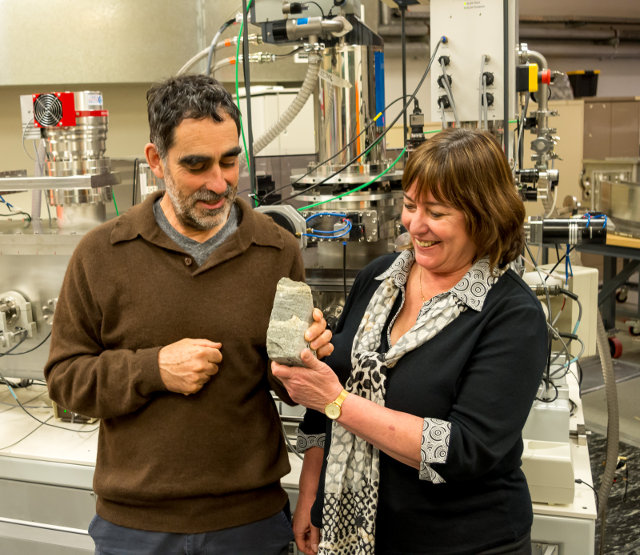
An article published in the journal “Nature” describes the discovery of microbial structures dating back to 3.7 billion years ago. A team of researchers led by Professor Allen Nutman of the University of Wollongong (UOW), Australia, discovered fossil stromatolites in the oldest sedimentary rocks in the world, in the Isua Greenstone Belt in Greenland. These fossils show that in such an ancient time there was already a diversity of life forms.
Stromatolites are sedimentary structures whose name is a made by the Greek words that mean “mat” and “stone” because they are formed from accumulations generated by microbial mats. So far, the earliest evidence of stromatolites of this type dated back to almost 3.5 billion years ago and for this reason Professor Allen Nutman pointed out that the ones discovered by his team are 220 million years older.
This new fossil discovered dates back to near the beginning of the existing geological traces on Earth and shows evidence that life existed on Earth really early in its history. The Isua stromatolites were exposed following the melting of an area that used to be of perpetual snow. Its characteristics suggest that they were laid down at a shallow sea floor off the coast of today’s Greenland. Those are carbonate minerals made by those ancient communities of microscopic life forms.
Today’s stromatolites can also be found on the bottom of shallow seas, such as the ones at the Bahamas and in Western Australia. Another similarity with young stromatolites is in its composition. In short, there are several clues that point decisively to the identification of this ancient stromatolite. This is important because there are non-biological processes that can generate similar formations, thus they need to identify with certainty the stromatolite.
3.7 billion years ago, as for most of Earth’s history, life forms were unicellular but they could form colonies and ecosystems. Precisely for this reason, a research was conducted and its results published in February 2016 about today’s stromatolites but it also provides information about the most ancient past of life on the planet.
Discoveries such as these ones provide new information on the early stages of life on Earth. 3.7 billion years ago the planet was still a very chaotic place with continuous asteroid impacts. The fact that in that situation there were already life forms that managed to survive will be studied further, also to understand if life forms existed on the planet Mars, where at that time the conditions were similar to the Earth.

Permalink