
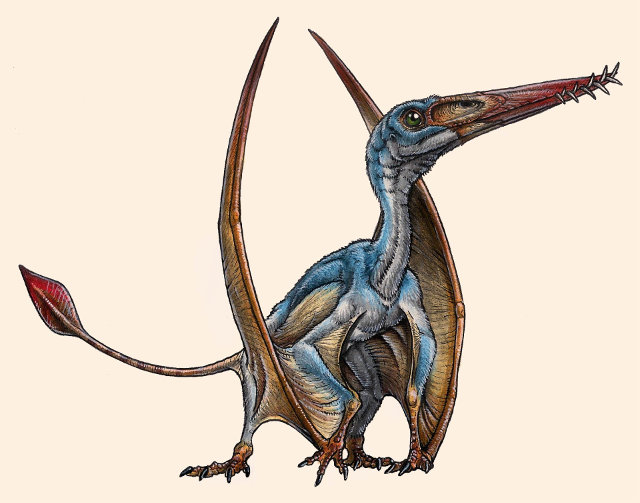
An article published in the journal “PeerJ” describes the discovery of a new species of pterosaur that was called Allkauren koi from the early Jurassic period. A team of scientists discovered a partial skeleton in the Cañadón Asfalto Formation, in the province of Chubut, Patagonia, Argentina, with a braincase in excellent conditions. For this reason its study can provide new information about the origins and evolution of these flying reptiles.
Pterosaurs – order Pterosauria – were flying reptiles and were the first flying vertebrates more than 200 million years ago, during the Triassic period, then disappeared during the greatest mass extinction of the end of Cretaceous. Sometimes mistakenly considered dinosaurs, their relation with other reptiles is still the subject of discussions.
Adapting to flight involved many anatomical changes and the limited availability of primitive forms of pterosaurs makes it difficult to understand their exact position in the classification among reptiles. As with other groups of animals so old, our understanding improves with every discovery of new fossils. In 2014, an exhibition of the American Museum of Natural History in New York allowed the public to discover the state of the art of the studies of these reptiles.
Some features of the pterosaurs were similar to those of birds, such as hollow bones full of air that made them lighter, favoring their ability to fly. However, their wings were formed by membranes of skin or other types of tissue. These membranes were attached to the fourth finger of each arm, which was in extremely elongated, and stretched on their hips to their ankles. The size of pterosaurs had a huge range, from the small Nemicolopterus, with their about 25 cm (10″) wingspan, to the huge Quetzalcoatlus northropi, with its wingspan of 10-11 meters (about 33-36 feet).
The knowledge about pterosaurs neuroanatomy is limited due to the small amount of three-dimensionally preserved fossils. Instead, in the case of Allkauren koi the braincase is very well preserved so the researchers could analyze it with a CT scan that allowed to reproduce its details, including its inner ear.
This exam allowed to see that the Allkauren koi’s skull had a combination of characteristics shared by both classical suborders in which pterosaurs were divided, Rhamphorhynchoidea and Pterodactyloidea. The specimen found lived about 170 million years ago and those characteristics provide new information on these reptiles’ evolution.
Before the discovery of Allkauren koi, paleontologists thought that certain features of pterosaurs’ skull had evolved later, near the Late Jurassic. The discovery of fossil earlier than that period is a rare event compared to later fossils so it’s important. It suggests that not only the origin and diversification of pterosaurs but also that of the other major lineages of vertebrates occurred earlier, at least in the Lower Jurassic.
