Biology

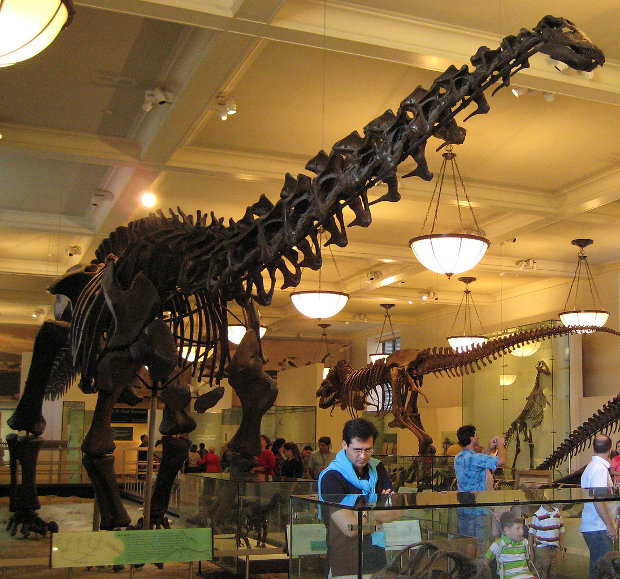
A scheleton of Apatosaurus excelsus, which now might be renamed Brontosaurus excelsus

For more than a century the brontosaurus (photo ©Elika & Shannon) was considered a species of the genus Apatosaurus classified as Apatosaurus excelsus. The name brontosaurus kept on being commonly used but in the field of paleontology it was believed to be an Apatosaurus. However, now a group of scientists published the results of a very thorough search on the online magazine “PeerJ” which explains why the brontosaurus make an independent genus.

An article published in the journal “Genome Biology” shows that many animals, including humans, acquired genes from microorganisms present in their environment in ancient times. This occurred through horizontal gene transfer (HGT), which transfers genetic material to cells that are not their descendants. The analysis of the genes of various species confirmed 17 genes previously identified as acquired in this way and identified another 128 in the DNA of humans.

Horizontal gene transfer has been known for a long time especially among microorganisms. It’s been identified in primitive multicellular creatures such as nematode worms and even in insects. Only in recent years studies started to assess it among complex plants and animals.

Ames scientists Michel Nuevo, Christopher Materese and Scott Sandford with one of the equipment used in their research (Photo NASA/ Dominic Hart)

A group of scientists at NASA’s Ames Research Center created uracil, cytosine and thymine, three nucleobases that are among the chemical components of RNA and DNA. This result was obtained by reproducing the conditions existing in the space, even interstellar. Obtaining these molecules by non-biological processes shows that at least part of life’s building blocks may have arrived on Earth after being formed in space.

To create the three nucleobases, NASA scientists started from pyrimidine, a molecule composed of hydrogen, carbon and nitrogen. It was found in meteors so there’s the certainty that it exists in space. Uracil, cytosine and thymine are derived from pyrimidine and the experiment aimed to verify that it was possible to obtain them under the conditions found in space.

A rock containing 2.3 billion years old bacteria fossils, visible in dark areas (Image courtesy J. William Schopf/UCLA Center for the Study of Evolution and the Origin of Life. All rights reserved)

An international team of researchers discovered a type of deep-sea microorganism that appears to have remained unchanged for over 2 billion years. There are many species considered living fossils because they remained very similar in the course of many million of years but this is a really extreme case. Those are sulfu-cycling microorganisms that are now found in mud off the coast of Chile and are indistinguishable from fossils that date back to different past eras.