Evolution

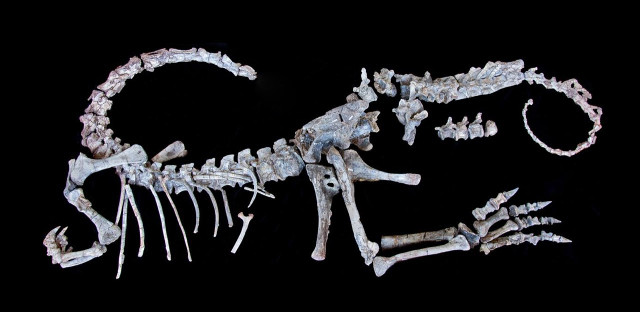
Sarahsaurus aurifontanalis skeleton (Image courtesy Jackson School Museum of Earth History Vertebrate Paleontology. All rights reserved)

An article published in the journal “PLOS One” describes a research on Sarahsaurus aurifontanalis, a relatively small dinosaur but part of the clade of sauropodomorphs, the giant dinosaurs that include iconic species such as brontosaurus. Paleontologists Adam Marsh and Timothy Rowe of the University of Texas at Austin Jackson School of Geosciences studied the fossils of this dinosaur that lived about 185 million years ago analyzing migrations and diversifications within its clade.

Examinations of the teeth of various hominins helps to understand their distribution in Europe and their evolution in the Pleistocene

Two articles published in the journal “PLOS ONE” describe two research on Pleistocene hominin teeth conducted by two teams with various researchers in common. A team led by Laura Martín-Francés of the French University of Bordeaux discovered various characteristics of Neanderthal teeth in the molars of a previous species named Homo antecessor from the Early Pleistocene. A team led by Clément Zanolli of the French University of Toulouse III Paul Sabatier examined the oldest dental remains discovered in Italy with an age estimated at about 450,000 years ago, concluding that they were similar to those of Neanderthals and distinct from those of modern humans.

Ledumahadi mafube bones and details of the discovery location (Image courtesy McPhee et al)

An article published in the journal “Current Biology” describes the discovery of a new giant dinosaur species in South Africa. Named Ledumahadi mafube by the team that examined it, led by Professor Jonah Choiniere, it was an herbivorous sauropod that had an estimated weight of around 12 tons for a height estimated at about four meters at its hips. In the Early Jurassic period in which it lived it was the largest land animal in the world.

Artist's concept of Mesosaurus in its environment (Image courtesy Roman Yevseyev and Graciela Piñeiro. All rights reserved)

An article published in the journal “Frontiers in Ecology and Evolution” describes a research on mesosaurs, the most ancient reptiles whose adaptation to aquatic life is known. A team of researchers carried out an accurate analysis of a number of fossils concluding that the bones of adults have similarities with those of land-dwelling animals and this suggests that they were semi-aquatic while their juveniles were aquatic. It’s a result obtained by examining fossils of specimens of various ages, a type of study that can reveal changes that occur with the growth of an individual of a species.

Ediacara fossils found in Namibia (Photo courtesy Simon A.F. Darroch. All rights reserved)

An article published in the journal “Nature Ecology & Evolution” describes a research on the communities formed by the so-called Ediacara biota, the beings that lived during the Ediacaran period. Paleontologist Simon A.F. Darroch of the Vanderbilt University and two colleagues applied a method of analysis developed for modern ecology to organisms of that period including some discovered in Namibia concluding that there was already an ecological complexity in some communities 570 million years ago.