Evolution

Nigel Goldenfeld and Thomas Kuhlman

An article published in the journal “Proceedings of the National Academy of Sciences” describes the possible role of transposons, commonly called jumping genes, in the emergence of eukaryotic organisms, the ones formed by complex cells that also include multicellular ones. A team of researchers conducted experiments in particular on retrotransposons, which to integrate into DNA require an RNA intermediate, to assess their effects on bacteria. The result is that a DNA repair mechanism typical of eukaryotes but rare in bacteria increases the efficiency of insertion and the effect of retrotransposons suggesting a possible role in the evolution of eukaryotes.

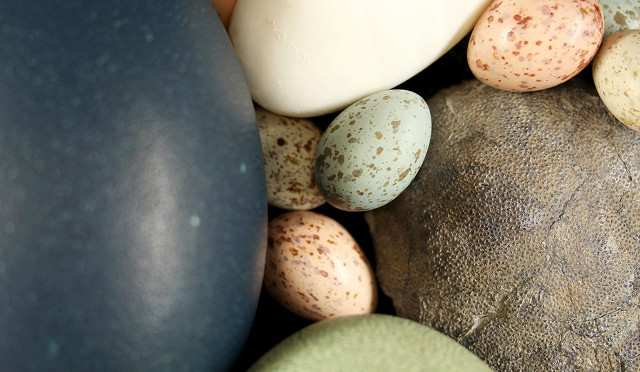
Bird eggs with a dinosaur egg (Photo courtesy Jasmina Wiemann/Yale University. All rights reserved)

An article published in the journal “Nature” describes a research on dinosaur eggs’ pigmentation and their link to bird eggs. A team of researchers led by molecular paleobiologist Jasmina Wiemann of Yale University analyzed 18 fossil dinosaur eggshells to look for traces of biliverdin and protoporphyrin pigments, the ones found in bird eggshells, finding them in Eumaniraptoran eggshells, a group that includes small carnivores such as Velociraptor. The conclusion is that pigmentation has a mimetic purpose that evolved in dinosaurs that created at least partially open nests.

Archaeopteryx albersdoerferi fossil (Image courtesy John Nudds. All rights reserved)

An article published in the journal “Historical Biology” describes the discovery of a new species of the genus Archeopteryx. A team of researchers examined a specimen discovered in the 1990s in a quarry in Bavaria, Germany, and passed through the hands of a number of owners. Thanks to a sophisticated microtomographic technique they were able to create a virtual representation that convinced them that it belongs to a species different from the two already known and they named it Archeopteryx albersdoerferi.

Piranhamesodon pinnatomus fossil (Image courtesy M. Ebert and T. Nohl)

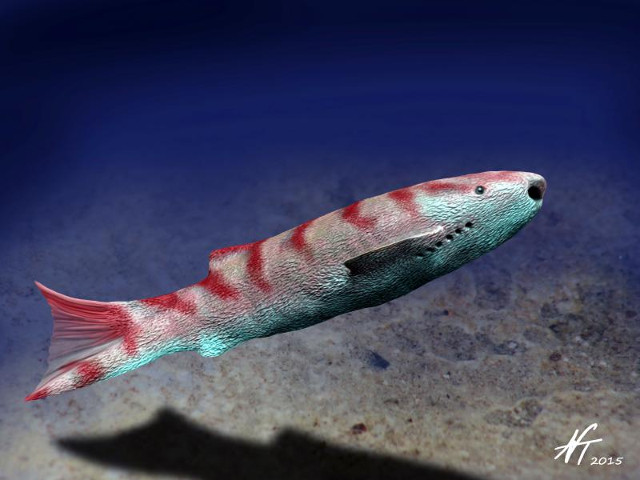
An article published in the journal “Current Biology” describes the discovery of a bony fish that lived about 150 million years ago. Named Piranhamesodon pinnatomus, it’s part of the collection of the Jura-Museum in Eichstätt and was discovered in the same limestone deposits in which Archeopteryx fossils were found, in southern Germany. The fossils discovered show that the this fish teeth were similar to those of modern piranhas and it probably used them in the same way.