Hominins

The vertebra found in the Ubeidiya site

An article published in the journal “Scientific Reports” reports the attribution of a vertebra to the genus Homo with an estimated age of about 1.5 million years in the archaeological site of Ubeidiya, in today’s Israel. A team of researchers examined the fossil vertebra and compared it with other Eurasian hominin fossils from the Pleistocene period. The paleobiological differences led them to conclude that there were several migratory waves from Africa that correspond to the different stone working techniques discovered in archaeological studies.

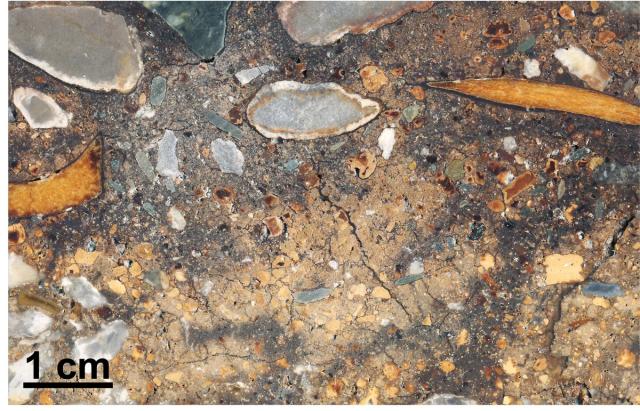
Sediment from Denisova Cave (Photo courtesy Mike Morley)

An article published in the journal “Proceedings of the National Academy of Sciences” reports the discovery of DNA of ancient hominins and animals dating back to the Pleistocene period in sediments taken from 13 prehistoric sites on different continents. A team of researchers including scientists from the Max Planck Institute for Evolutionary Anthropology in Leipzig and geoarchaeologists collected and analyzed sediments and found that even microscopic fragments of bone and feces offer concentrations of DNA belonging to various species. That’s another step forward in the recovery of very ancient genetic material that can offer valuable information on populations of Neanderthals and other hominins whose presence can be linked to archaeological artifacts and ecological traces.

Bone fragments from Denisova Cave (Photo courtesy Samantha Brown)

An article published in the journal “Nature Ecology and Evolution” reports the identification of new fossil bones belonging to the Denisovans, the hominin species still mysterious from various points of view. A team of researchers led by Katerina Douka conducted a very sophisticated analysis of nearly 3,800 bone fragments too small to be identified by normal methods and found five that belonged to humans, four containing enough DNA fragments to establish that three belonged to Denisovans and one to a Neanderthal. The bones were found in a layer of Denisova Cave dating to as early as 200,000 years ago, making them some of the oldest human fossils from which it was possible to extract DNA. They’re important fossils also because they were discovered in the same sediments as animal remains and stone tools that offer information about that people’s life.

A silhouette of Australopithecus sediba showing the available bones with the vertebrae and their 3D reconstruction

An article published in the journal “eLife” reports a study of Australopithecus sediba’s spine. A team of researchers created 3D reproductions of fossil vertebrae discovered in 2015 during excavations at the Malapa site, where the first bones attributed to this hominin species were discovered. This allowed obtaining an almost complete lower spine of the specimen cataloged as MH2 whose characteristics confirm the conclusions of previous studies that indicated that these australopithecines used their arms to climb trees like apes but used their legs in bipedal walking like the later species of the genus Homo.

A reconstruction of Leti's skull in Professor Berger's hand

Two articles published in the journal “PaleoAnthropology” report as many studies connected to Homo naledi, the species of hominins whose fossils were discovered in the cave called Rising Star about 50 km northwest of Johannesburg, South Africa. One of the two articles reports the study of a partial skull with some teeth belonging to an individual who was still in the growth phase, possibly a child. The other article reports the results of the exploration of the subsystem of the cave called Dinaledi. These studies offer new insights into what Professor Lee Berger, who led the team that conducted the first studies on Homo naledi, called an enigmatic species.