Hominins

The Bodo 1 skull (Image courtesy Jeffrey H. Schwartz / Roksandic et al.)

An article published in the journal “Evolutionary Anthropology” reports a research on hominins of the Middle Pleistocene period that proposes the species Homo bodoensis as a classification for a series of hominin fossils discovered in Africa and some discovered in some areas of Europe. A team of researchers led by paleoanthropologist Mirjana Roksandic of the University of Winnipeg, Canada, reached this conclusion after reassessing fossils discovered over the years in Africa and Eurasia. A consequence of this proposal is the elimination of the species Homo heidelbergensis and Homo rhodesiensis with their often inconsistent definitions. A series of fossils attributed to the species Homo heidelbergensis would be Neanderthals.


Aeta actors on stage

An article published in the journal “Current Biology” reports the results of a genetic research on 118 ethnic groups living in the Philippines which indicated that in the Aeta, or Ayta, people and in particular in the Aeta Magbukon ethnic group there is the greatest concentration found so far of genes inherited from the Denisovans, the human species whose remains identified with certainty have been discovered mainly in Siberia. A team of researchers conducted this genetic research within a collaboration between the Swedish University of Uppsala, the National Commission for Culture and the Arts of the Philippines (NCCA), and various indigenous communities. The results show an ancient interbreeding between the Aeta and the Denisovans.

Harbin Cranium

Various articles report the results of separate studies on fossils belonging to species of the genus Homo whose identification is based on fossils discovered in China and Israel, respectively. In both cases, the publication caused controversy. Three articles published in the journal “The Innovation” report various aspects of the identification of what was named Homo longi, based on a skull dated at least 146,000 years discovered in modern-day China. Three articles published in the journal “Science” report various aspects of the identification of a population that belongs to the genus Homo for now indicated only as Homo from Nesher Ramla, based on fossils dated between 120,000 and 140,000 years ago.

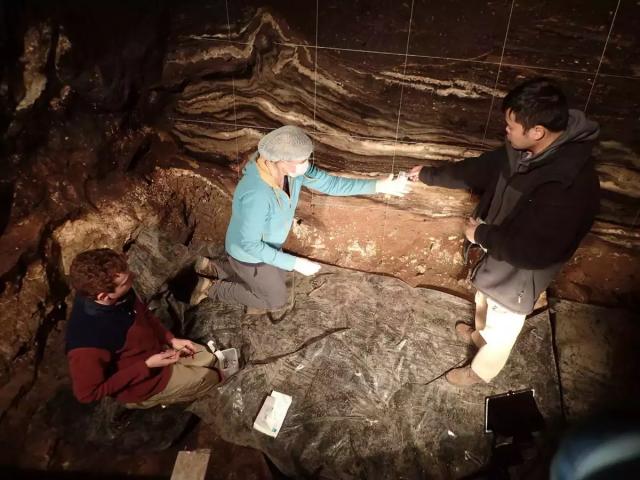
Researchers Zenobia Jacobs, Bo Li and Kieran O'Gorman during sample collection (Photo courtesy Dr. Richard G. Roberts. All rights reserved)

An article published in the journal “Nature” reports the results of the sequencing of DNA found in the sediments of the Denisova Cave, in Siberia. A team of researchers achieved the largest sequencing ever conducted on genomes recovered from sediments from a single site with 728 samples. The results offer a picture of the occupation of that cave over a period of more than 300,000 years by three human species: the Denisovans, the Neanderthals, and the Homo sapiens. However, most of the samples turned out to be DNA from various animals, which is also useful because it offers information on the connection between humans and the species that various populations ate.

A schematic of how the system called genomatnn recognizes adaptive introgression

An article published in the journal “eLife” reports the development of an approach based on convolutional neural networks (CNNs) to identify genes inherited from other species such as Neanderthals that brought positive effects. A team of researchers led by Graham Gower of the Danish University of Copenhagen developed this deep learning technique to examine genomes of modern humans for examples of what is technically called introgression, which means genes that a hybrid between two species brought into one of his parents’ species. Various possible examples have been found, for example, genes inherited from Denisovans have been found in Melanesians that affect various metabolic and disease-related traits.