Hominins

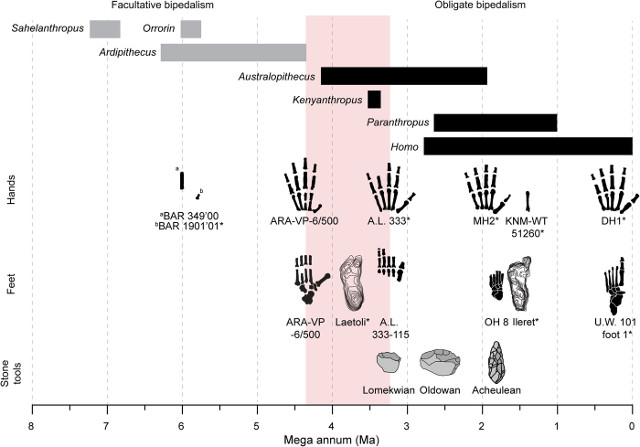
A scheme of the evolution of the hands and feet of hominins

An article published in the journal “Science Advances” reports a study of the hands of Ardipithecus ramidus, a hominin that lived about 4.4 million years ago. Thomas Cody Prang, a professor of anthropology at Texas A&M University, and some colleagues examined the particularly well-preserved fossil hands of the specimen nicknamed Ardi. A comparison with the hands of modern humans, apes, and monkeys provided new insights into their evolution and connection with their locomotion showing a correlation between the evolution of hand and foot characteristics.

Scheme of facial features associated to various genes

An article published in the journal “Science Advances” reports a genetic study on Native Americans of South America concerning the identification of a number of their genetic regions that influenced their facial features. Some of them were inherited from the Denisovans, another human species now extinct. A team of researchers used genetic data from 6,192 Latin American volunteers involved in a large study by the CANDELA (Consortium for the Analysis of the Diversity and Evolution of Latin America) consortium to identify genes inherited from the Denisovans. This will help investigate the ancestry of Native Americans in Asia, where the only traces of this species have been found.

Molar of the Neanderthal man cataloged as Spy 94a

An article published in the journal “Science” reports the results of the sequencing of the Y chromosome, the one that determines the male sex among humans, of three Neanderthals and two Denisovans. A team of researchers led by Martin Petr and Janet Kelso of the Max Planck Institute for Evolutionary Anthropology performed high-quality sequencing using a very advanced approach to obtain the genetic sequences of the Y chromosomes of a total of 5 hominins. This made it possible to compare them with each other and with those of modern humans to obtain new information on the relationships among the various species. An interesting conclusion is that the Neanderthal Y chromosome was received from Homo sapiens with whom they must have interbred much earlier than we thought, no less than 100,000 years ago and possibly even 370,000 years ago.

The population model used in the research

An article published in the journal “PLOS Genetics” reports a genetic study showing the traces of various interbreedings between different species of hominins. Melissa Hubisz and Amy Williams of Cornell University and Adam Siepel of Cold Spring Harbor Laboratory developed a genetic analysis software that can recognize relations and applied it to a group of genomes that includes two Neanderthals, a Denisovan, and two African modern humans. The result is evidence that 3% of Neanderthal DNA came from ancient humans in an interbreeding between 200,000 and 300,000 years ago, 1% of Denisovan DNA came from an older species, maybe Homo erectus, and 15% of that “superarchaic” DNA may have been passed on to modern humans.

Reconstruction of Turkana Boy's upper body

An article published in the journal “Nature Ecology & Evolution” reports a study of the fossils of the so-called Turkana boy, the most complete early human skeleton found so far. A team of paleoanthropologists led by Markus Bastir of the Museo Nacional de Ciencias Naturales in Madrid and Daniel García-Martínez of the Centro Nacional de Investigación sobre la Evolución Humana (CENIEH) in Burgos, Spain, created a three-dimensional reconstruction of the Turkana boy’s rib cage to compare their characteristics with those of other hominins. The result is that it was stockier than Homo sapiens, different from the idea of ​​the first runners that paleoanthropologists have of Homo erectus and Homo ergaster.