
An article published in the journal “Science Advances” reports a study of the hands of Ardipithecus ramidus, a hominin that lived about 4.4 million years ago. Thomas Cody Prang, a professor of anthropology at Texas A&M University, and some colleagues examined the particularly well-preserved fossil hands of the specimen nicknamed Ardi. A comparison with the hands of modern humans, apes, and monkeys provided new insights into their evolution and connection with their locomotion showing a correlation between the evolution of hand and foot characteristics.
Ardipithecus ramidus (photo of the skeleton of the individual nicknamed Ardi ©Chartep) is a hominin whose fossil remains have been discovered starting from 1992 in Afar, Ethiopia, not far from the place where the fossil bones of Lucy, the famous specimen of Australopithecus afarensis, were found.
The anatomical characteristics of Ardipithecus ramidus, also examined in other specimens discovered in subsequent years, stimulated the interest of various researchers who are studying the evolution of hominins. An article published in the journal “eLife” in April 2019, written by a team also led by Professor Thomas Prang, focused on the study of the feet of this ancient hominin to assess its role in the evolution of bipedal locomotion up to humans.
The new study conducted by Professor Thomas Prang and his colleagues focused on the hands of Ardipithecus ramidus while keeping an interest in its feet. Prang explained that the shape of the hands reflects adaptations to particular habitats and lifestyles, and by finding the connections between bone shape and behaviors in living species, it’s possible to obtain inferences about the behaviors of extinct species.
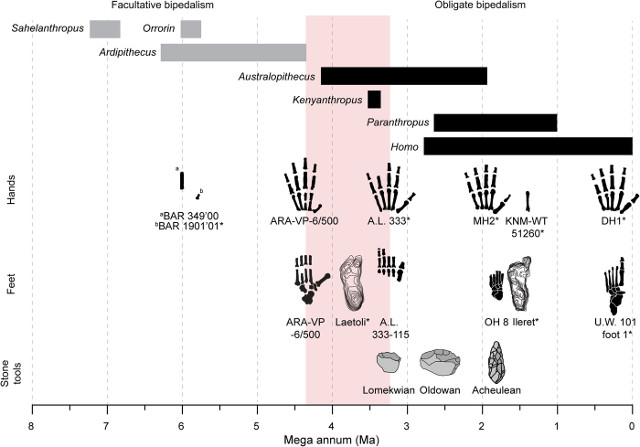
The image (Courtesy Thomas Prang et. Al. All rights reserved) shows a scheme of the evolution of the hands and feet of hominins reflecting an evolutionary shift towards more advanced manipulation skills and forced bipedalism.
 According to the researchers, the hand of Ardipithecus ramidus represents an earlier phase in human evolutionary history that is important because it shows the characteristics of the ancestors of humans and chimpanzees. In the species that came after Ardipithecus ramidus, there was a remarkable evolutionary leap with hands more suited to performing sophisticated work. That’s the period from which the first known stone tools date back.
At the same time, there was a shift to bipedal locomotion with a diversification from the ancestors of chimpanzees. For example, the ancestors of humans lost their grasping big toe in the adaptations that led to the feet of later hominins. The common ancestor of humans and chimpanzees probably had adaptations to a suspensory life on trees.
The idea of the correlation between the evolution of hands and feet in hominins is not new, so much so that it was proposed by Charles Darwin. Anatomical studies comparing Ardipithecus ramidus with various species of apes, monkeys, and hominins are confirming this old hypothesis.
