Planets

Diagrama of the planetary system of the star GJ 667C, also known as Gliese 667C (Image ESO)

The star GJ 667C (also known as Gliese 667C) rose to the spotlight a little more than a year ago, when a scientific study led to the identification of three planets and the one called GJ 667Cc was in the habitable zone of its star. Some doubt was expressed regarding this discovery but a new research, conducted by Guillem Anglada-Escudé of the University of Göttingen, Germany, and Mikko Tuomi of the University of Hertfordshire, UK, led to the conclusion that the star has at least 6 planets of which 3 in its habitable zone.

Comparison between the Kepler-62 system and our internal solar system (Image NASA Ames/JPL-Caltech)

Thanks to NASA’s Kepler space telescope it’s been discovered that the star Kepler-62, approximately 1,200 light-years from the Sun, has five planets and the star Kepler-69, approximately 2,700 light-years from the Sun, has two planets. The most interesting news is that two of Kepler-62 planets and one of Kepler-69 planets are probably of the rocky type and their orbit is within the habitable zone of those solar systems.

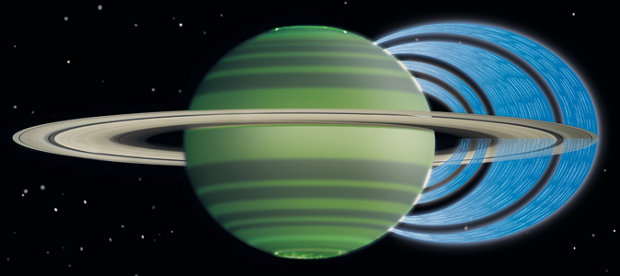
Artist's concept illustrating how charged water particles flow into Saturn's atmosphere from the planet's rings (Image NASA/JPL-Caltech/Space Science Institute/University of Leicester)

In an article published on “Nature”, a team of scientists led by James O’Donoghue, University of Leicester, England, explains how a rain of charged particles from Saturn’s rings falls on the planet in much greater quantities and on a much wider area than previously thought.