
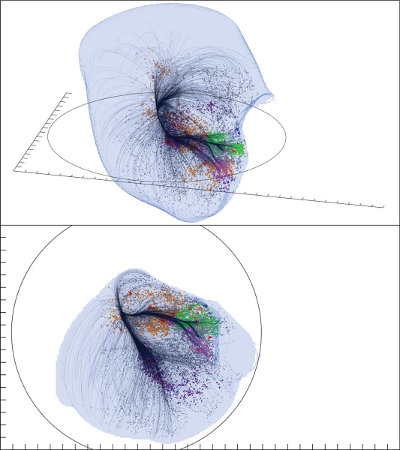
An international team of astronomers led by R. Brent Tully of the University of Hawaii determined the boundaries of a galactic supercluster that includes the Milky Way. In the article in the journal “Nature” that illustrates this research it’s explained how the astronomers defined the contours of this supercluster they called Laniakea, a word in the Hawaiian language which means “immense heaven”.
R. Brent Tully is a specialist in galaxy astrophysics and the author of important studies on this subject since the ’70s. This year he won the Gruber Cosmology and Victor Ambartsumian International awards, now he added to his long and distinguished career this new study about galactic superclusters, which offers a new way to analyze those immense structures.
Galactic superclusters are among the largest structures in the universe. They’re composed by smaller galaxy groups. Everything is relative so some of these groups are actually clusters containing hundreds of galaxies. The so-called Local Group, the one that contains the Milky Way, is made up of a few dozen galaxies.
All these groups are interconnected in a single structure composed of a total of about one hundred thousand galaxies. The Laniakea supercluster is truly immense as it has a diameter estimated at 500 million light years and a total mass that is 10^17 (that is one hundred million billion) the Sun. These are numbers that are totally beyond any possible experience for a human being!
To map the boundaries of the Laniakea supercluster, so far poorly defined, and other similar structures, astronomers have proposed a new way to evaluate these galactic structures by examining their impact on the dynamics of galaxies. The force of gravity is the key factor in this evaluation, specifically the authors of this research mapped the velocity of galaxies determined by the gravitational effects of other galaxies to understand the reach of a supercluster’s influence.
This mapping was based on observations at the Green Bank Telescope (GBT) and other radio telescopes. They allowed to define the region of space in which each supercluster is dominant. Inside Laniakea, the movements are directed inward, like water streams that follow paths towards a valley.
The equivalent of one of those valleys is called the Great Attractor, a gravitational anomaly that attracts the surrounding galaxies for many millions of light years. It’s been studied for over thirty years, this new research provides insight into its role within the Laniakea supercluster.
This research was possible not only thanks to various modern radio telescopes but also thanks to the new computer analysis technologies. These studies can be further developed to improve our understanding of large structures in the universe.
[ad name=”eBayUSUKAstronomy”]

Permalink