
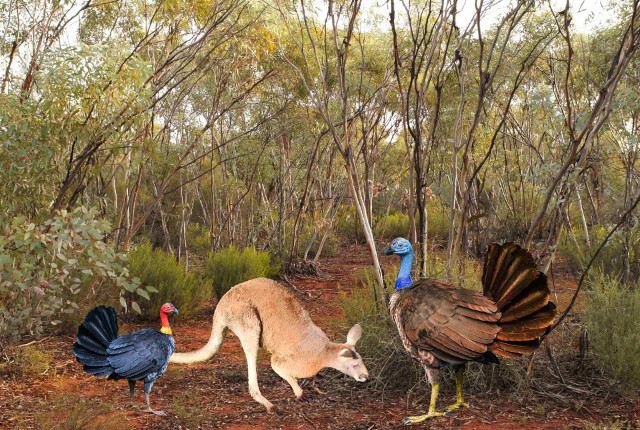
An article published in the journal “Royal Society Open Science” describes a research on megapodes, a family of birds widespread in many parts of Oceania that includes various extinct species. A team of paleontologists at Flinders University reviewed several Australian fossils and proposed a new classification in five extinct species with various relationships with extant species.
Some giant megapodes, which could resemble giant turkeys, lived between the late Pliocene and the Pleistocene, more or less between 5 million and 11,000 years ago. Unlike other giant birds, including species that lived in Australia such as the dodo, they could fly. Understanding their relationships was complicated and their classification has been the source of various discussions, a situation too common in the field of paleontology, where often there are just a few fossils and incomplete.
In the case of these ancient Australian birds, the first fossils were found in Queensland in the 1880s up to those found in the Naracoorte Caves in the 1970s. At the beginning of the last decade other fossils of various species of Australian megafauna were found in southern Australia and fossils included other megapodes. In short, a complex situation because there were many fossils scattered here and there discovered in the course of a very long time.
In such cases, a research such as the one conducted by the Flinders University team, focused on the specific examination of certain fossils, and the comparison among them can make great progress. The paleontologists examined a number of fossils discovered in Australia over the decades, classified in various species and part of the discussions that followed.
According to the Flinders University team, the fossils belong to 5 different species: Galluracea progura and Progura campestris, Garrdimalga mcnamarai, Latagallina naracoortensis and Latagallina olsoni. progura Galluracea was the most massive with an estimated weight of about 7.7 kg while other species were smaller, with weights ranging from the 2.9 kg of Latagallina olsoni to the 6.2 kg of Progura campestris.
This research focused on these species indicates that half of the Australian megapodes disappeared in the Pleistocene but this is clear only now. This shows that the history of these animals is known in a still very limited way. It’s now possible that other scientists will raise criticism and objections but surely this study will help clarify the history of megapodes.
