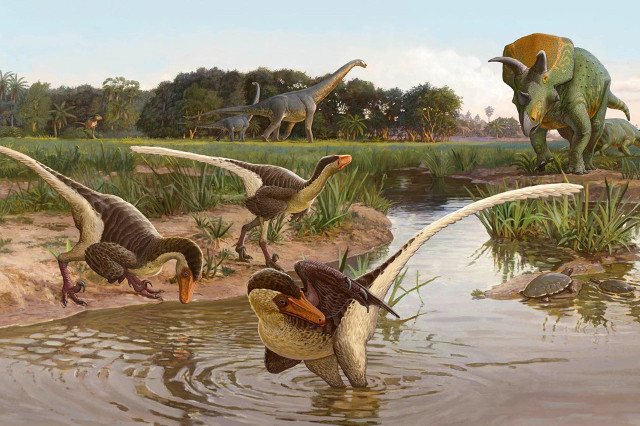
An article published in the journal “Scientific Reports” describes the identification of a feathered dinosaur that lived about 67 million years ago, in the Cretaceous period, in today’s New Mexico, USA. Steven E. Jasinski, Robert M. Sullivan, and Peter Dodson named it Dineobellator notohesperus after studying the available bones, only a few of them but enough to establish that it was a new genus, albeit closely related to the Velociraptor. These species are cataloged in the Velociraptorinae subfamily and in the Dromeosauridae family, a group of generally small and lightly built dinosaurs, so their remains are rare and any new discoveries help to reconstruct the history of the non-avian dinosaurs that could be the closest relatives of modern birds.
Dromeosaurids (Dromaeosauridae) originated perhaps in the Mid Jurassic period and diversified into various species until their extinction at the end of the Cretaceous period, together with all the non-avian dinosaurs. They were popularized by the movie “Jurassic Park” and some species were nicknamed raptors, but they were relatively small, with a size comparable to that of a man.
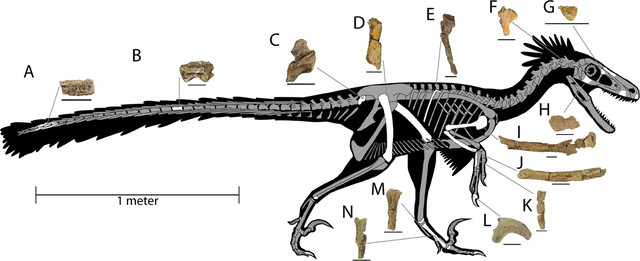
The few bones of the species later named Dineobellator notohesperus (Top image above courtesy Jasinski et al) were discovered since 2008, when Robert M. Sullivan, Steven E. Jasinski, and James Nikas found the first bones in the Ojo Alamo Formation, a fossil deposit in New Mexico where remains of many animals were discovered, not just dinosaurs. In 2009 Sullivan and Jasinski found more bones, and in January 2011 the discovery was reported along with those of other fossils in an article published in the bulletin of the “New Mexico Museum of Natural History and Science” together with Spencer G. Lucas. A further discovery of bones was made by Jasinski in 2015 and 2016. Finally, Sullivan and Jasinski studied the bones available together with Peter Dodson giving the name to the new species.
The study of fossils of Dineobellator notohesperus revealed some characteristics typical of Dromeosaurids, and others specific of this species such as a flexible tail. A very interesting discovery is that of traces of plumage, a new clue that it was common among the species of its taxonomic family. In fact, over the years traces of feathers have been found in other species of Dromeosaurids, even in some unable to fly. In various species of modern birds of prey, the feather colors are useful for camouflage and/or as a sexual display, so it’s possible that this was true for some of their distant raptor cousins as well.
Plumage in dinosaurs in general has been a hot topic of discussion in recent years, and any new discoveries can add new information to better understand how common it really was. In Dineobellator notohesperus’s case, we’re talking about a group already known for plumage and its discovery is also useful to understand how they hunted.