
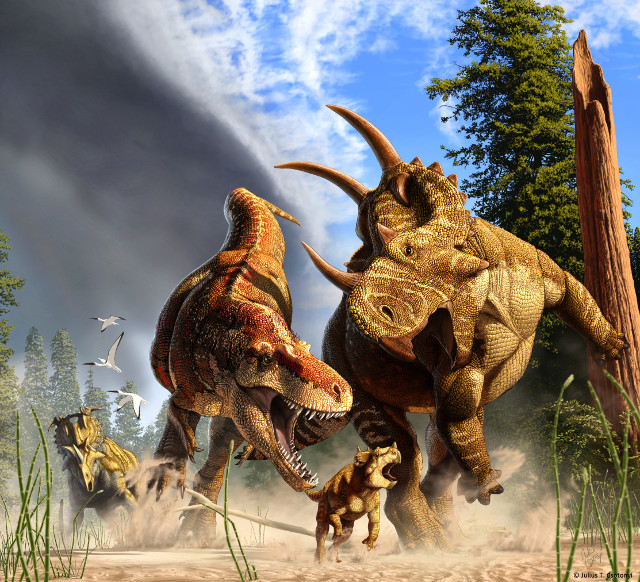
An article published in the journal “PLOS ONE” reports a study on the locomotion capabilities of the dinosaurs of the theropod group, and in particular of more than 70 species belonging to the carnivorous groups Tyrannosauridae, which includes T. rex, Allosauroidea and Ceratosauridae. A team of researchers considered various physical characteristics to evaluate the allometry impact on those dinosaurs’ ability to run and the limiting effect of their size, aspects that are generally overlooked. One conclusion is that large predators such as T. rex had the advantage of efficiency thanks to their long legs, not of speed as previously thought.
Tyrannosaurus rex is an iconic predator, but other theropod dinosaurs were also fearsome predators during the Mesozoic era, and not only among its closest relatives. In some families of theropods, large species weighing more than 1,000 kg emerged, and paleontologists believed that longer legs favored their speed, an advantage for any predator. According to the authors of this new research, the issue is more complex.
The researchers analyzed a range of anatomical data relating to more than 70 theropod dinosaur species. Within this group, the species had very different sizes with the peaks emerging independently in some groups of predators such as Tyrannosauridae, Allosauroidea, and Ceratosauridae. Their data made it possible to estimate the top speed that each species could reach to understand if having longer legs really allowed them to run faster. They also estimated how much energy they used when walking at moderate speed.
The results obtained indicate that leg length wasn’t an advantage in terms of running speed for all species. In fact, this seems true only for small and medium-sized species, but not for those with a weight greater than 1,000 kg. This confirms the idea that size was a limiting factor concerning running speed.
Another result of the allometric analysis shows that large, long-legged, theropods moved more efficiently. The researchers calculated how much energy the various dinosaurs spent walking, finding that larger species with longer legs needed less energy. Predators spend a lot of time looking for prey around their hunting ground so a greater walking efficiency was an advantage. In essence, the T. rex and some of its big cousins weren’t great sprinters, but could walk very long without getting tired.
Top predators such as T. rex probably also had other physical advantages besides their devastating bite. For example, the researchers hinted at the possibility that they could turn more quickly than other predators. Further studies based on the physical characteristics of T. rex and other predator theropods could more fully explain the reasons for their success.
