2020

Patrick George Troughton was born on March 25, 1920 in Mill Hill, Middlesex, England. After the end of World War II, Patrick Troughton returned to work as an actor on stage. After a couple of years he started getting roles in television and cinema productions. His career developed mainly on television and in 1953 he became the first actor to play Robin Hood on TV in a BBC miniseries. During the 1950s, he earned increasing fame by participating in many television productions.

In 1966 the production staff of “Doctor Who” was struggling with the problem of choosing whether to end the show due to actor William Hartnell’s health problems or try to replace him as the Doctor. Patrick Troughton agreed to take over and played the Second Doctor until 1969, when he left the show for fear of getting typecast.

More Than Human by Theodore Sturgeon (Italian edition)

The novel “More Than Human” by Theodore Sturgeon was published for the first time in 1953. It’s the result of the union of a novella previously written with two other parts written specifically to obtain the novel. It won the International Fantasy Award.

The idiot’s life has always been lonely, but when by chance he meets Evelyn Kew a mental contact between the two of them creates a human contact as neither of them had ever experienced. Unfortunately, the girl’s insane father attacks the idiot seriously injuring him and, when Evelyn tries to stop him, he mortally wounds her. The idiot gets rescued by the Prodds, a farming couple who takes care of him and somehow adopts him.

After some years, Mrs. Prodd gets pregnant and the idiot leaves the couple to return to live on his own. The meeting with Janie, a telekinetic child, and with the twins Bonnie and Beanie, capable of teleporting, starts a sort of symbiosis. The idiot returns to the Prodds and discovers that the son they had suffers from Down syndrome, yet he has superhuman mental abilities that make him become the mind of a gestalt.

Dr. Daniel Field holding a replica of Asteriornis maastrichtensis skull (Photo courtesy University of Cambdridge)

An article published in the journal “Nature” reports the identification of a new primitive bird that lived near the end of the Cretaceous period, almost 67 million years ago, near the border between today’s Belgium and Holland. A team of researchers led by the University of Cambridge subjected the fossil bones of what was named Asteriornis maastrichtensis to a high resolution CT-scan to create 3D reconstructions. In particular, the skull is one of the best preserved among bird fossils. Its characteristics bring together those of modern chickens and ducks, suggesting that it’s a species very close to their last common ancestor.

Jean-Luc Picard (Patrick Stewart) and 7 di 9 (Jeri Ryan) in Et in Arcadia Ego, Part 1 (Image courtesy CBS All Access / Amazon Prime Video)

“Et in Arcadia Ego, Part 1” is the ninth episode of the TV show “Star Trek: Picard” and follows “Broken Pieces”. It’s available in the USA on the CBS All Access streaming platform and in many other countries on Amazon Prime Video.

The starship La Sirena reaches the home planet of Soji (Isa Briones), where it’s intercepted by the starship piloted by Narek (Harry Treadaway) and subsequently reached by the Borg cube, reactivated by 7 of 9 (Jeri Ryan). The planet’s defenses disable all the starships, which are forced to land. On the planet, the first truths about synthetic organisms emerge.

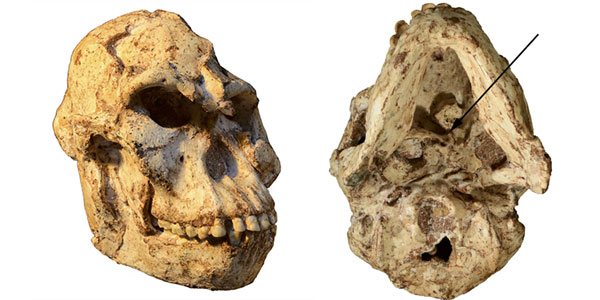
Little Foot's skull

An article published in the journal “Scientific Reports” reports a study on the characteristics of the skull of the specimen of Australopithecus nicknamed “Little Foot” that offers information on this species’ life. A team of researchers from Wits University led by Dr Amélie Beaudet examined a 3D reproduction of the fossil generated by subjecting it to a high resolution micro-CT scan. The presence of the first cervical vertebra has a crucial role in the biology of vertebrates and the Little Foot’s one is in its place offering information on the possible head movements for this species of Australopithecus, different from those possible for modern humans.