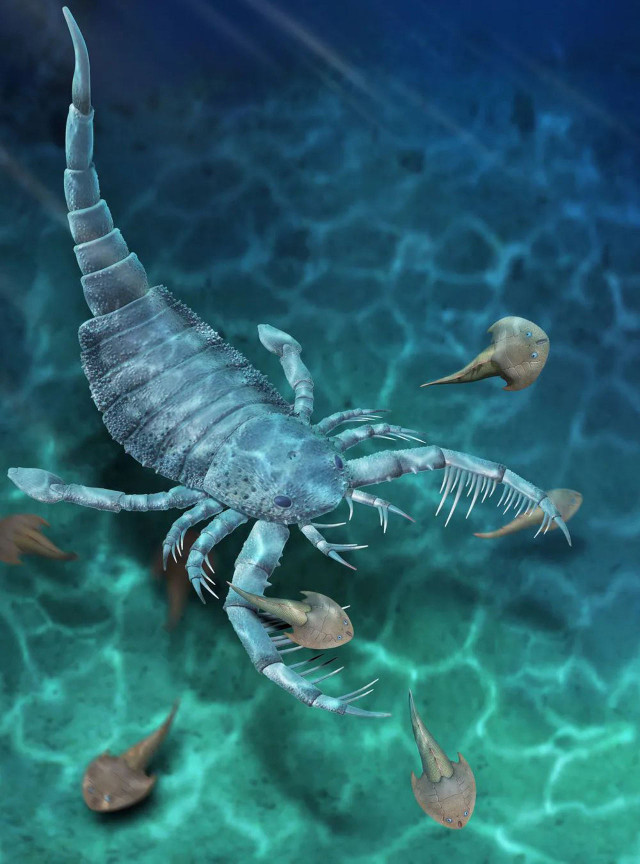
An article published in the journal “Science Bulletin” reports the identification of Terropterus xiushanensis, a species belonging to the order of the eurypterids (Eurypterida), the so-called sea scorpions, which lived about 435 million years ago, during the Silurian period, in today’s China. A team of researchers examined several fossils discovered in the Xiushan Formation and concluded that it belongs to a genus from the ones known and attributed it to the Mixopteridae family. It’s the first sea scorpion attributed to that family discovered in China.
Eurypterids are in the extinct order of arthropods commonly known as sea scorpions even though it’s a misnomer. They were part of the group of chelicerates, so they were related to scorpions but for their characteristics form a separate group, closer to the so-called horseshoe crabs of the Limulidae family. Probably, they developed in the Cambrian, about 510 million years ago, and became extinct in the Permian, about 260 million years ago.
So far, eurypterids of the Mixopteridae family were discovered in various areas of Europe and North America. Their characteristics include particularly large and thorny prosomal (head) limbs. They were probably used for catching prey in a similar way some spiders, very distant cousins of sea scorpions, use today. Terropterus xiushanensis also exhibits that type of limb.
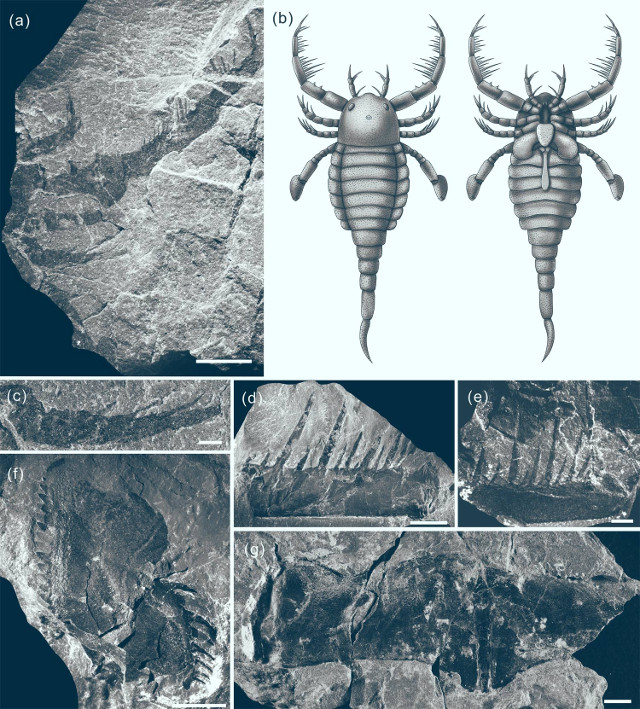
The fossils discovered suggest that it could be larger than the other members of its family, as it’s estimated that it could reach one meter in length against the approximately 75 centimeters of Mixopterus simonsoni. The top image (Courtesy Wang et al. All rights reserved) shows some of the fossils together with two drawings that reconstruct the dorsal and ventral views of this eurypterid.
Probably, Terropterus xiushanensis was a top predator in the marine ecosystem of the Silurian period in which it lived. That’s because there were no large vertebrates at the time that could compete with the arthropods that existed in that era and were giants compared to their present-day relatives. Most eurypterids were comparable in size to modern insects and arachnids but some species were much larger, up to two meters in length.
The discovery of the first eurypterid fossils of the Mixopteridae family in modern-day China suggests that they were spread much more than previously thought and that this conclusion was erroneous due to limitations in fossil collection. That’s a common problem in the field of paleontology, so reconstructions of ancient ecosystems can change radically following the discovery of new species.
The researchers believe that future work, especially in Asia, may reveal a more widespread presence of species from the Mixopteridae family and possibly other groups of eurypterids as well. Today there’s less oxygen in the atmosphere than in the Silurian, so arthropods, with their limited breathing systems, can no longer be that large.