
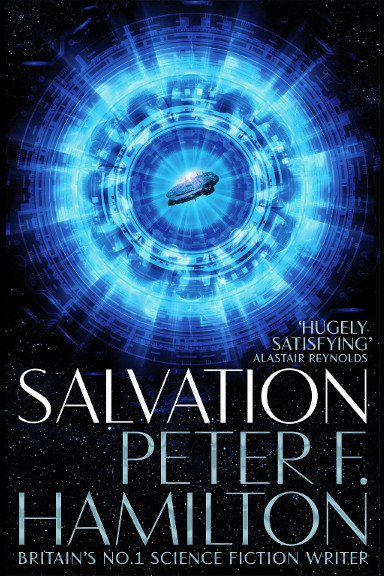
The novel “Salvation” by Peter F. Hamilton was published for the first time in 2018. It’s the first novel in the Salvation Sequence.
In 2204 humanity is expanding among the stars using portals based on quantum entanglement. On a recently discovered planet about 89 light-years from Earth, the wreck of an alien spaceship is discovered, and inside it, there are 17 humans. A very special team is sent to investigate but one of the members is an alien.
Centuries later, humans are on the run from aliens who want to wipe them out. The only hope is to raise soldiers trained specifically to fight the aliens. That’s because it’s impossible to escape from the enemies forever, so the only solution is to prepare for the fight.
Peter F. Hamilton is one of the most famous authors of the new space opera of this beginning of the third millennium. His works are complex, with various subplots intertwining in ways that are sometimes clear only after a few hundred pages. A series by this author can easily exceed 2,000 pages. All this is also true in this series, in which the subplots are set in different times, divided between the 22nd / 23rd century and in a future centuries later.
Certain elements of the novel are typical of the beginning of a Peter F. Hamilton series with the introduction of the various important characters in the various subplots and the threat, in this case by an alien species. The first novel of a series by this author is normally in many ways a great prologue in which the foundations of a big story are developed and that’s is true in this case as well.
My problem with this novel is in its structure. Typically, novels with various subplots alternate them in the various chapters but in this case, the structure is more complex. There’s an alternation between the subplots set in the two eras but the story of the team that investigates the alien spaceship in 2204 is in turn frame story that contains the various team members’ personal stories. The consequence is that the novel mainly tells the stories of the team members alternating them with those of their investigation in 2204 which in turn are alternated with the subplot set centuries later.
The structure chosen by Peter F. Hamilton has consequences on the pace and above all on the balance of the narrative. For example, Callum and Savi’s story is told in a single chapter that, in the edition I read, is 140 pages long and decades ago would have been considered a novel. This chapter is in the initial part of the novel, so there’s time to pick up the narrative thread but you might struggle to remember characters who had just been introduced in the initial pages.
In the end, in my opinion, the strength of what is the initial part of a great story is in the construction of the fictional universe in the two timelines. Peter F. Hamilton explores the consequences of humanity’s expansion into space and the contact with alien species. At the end of the 22nd century, certain social dynamics still seem similar to the current ones but the author also showed possible social experiments that are supposed to create a utopia discussing its strengths and weaknesses through the characters.
Various twists, especially in the final part of “Salvation”, offer the first answers regarding the investigation of the alien spaceship and the timeline in the distant future. Honestly, in some cases, I had a been-there-done-that feeling since I have already read several novels by Peter F. Hamilton and various elements seem similar to famous stories by other authors. I found it less convincing than the beginning of other series by this author but still good enough to make me curious about its development.
