2021

Slow Bullets by Alastair Reynolds

The novella “Slow Bullets” by Alastair Reynolds was published for the first time in 2015. It won the Locus Award as the Best Novella of the Year.

Scur fought in the war between Peripheral Systems and Central Worlds and didn’t even have time to rejoice about its end that she was captured by Orvin, a war criminal. Orvin inserts a second slow bullet into Scur’s body, a memory device that adds to the one all soldiers have but without using painkillers.

Left for dead, Scur is saved but wakes up on the spaceship Caprice. The systems onboard seem to have major problems and there are soldiers on board who fought for both sides during the war. Scur discovers that Orvin is also on board but the attempts to capture him are hampered by the ship’s problems, which can only be explained if the people on board remained hibernated for many centuries.

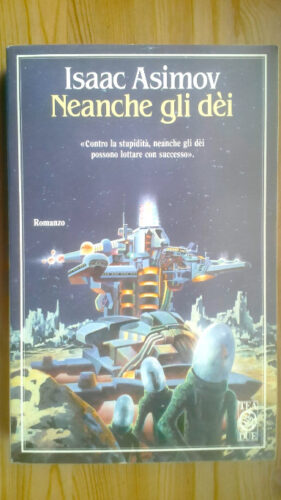
The Gods Themselves by Isaac Asimov (Italian edition)

The novel “The Gods Themselves” by Isaac Asimov was published for the first time in 1972, first serialized in the magazines “Galaxy Magazine” and “Worlds of If” and then as a book. It won the Hugo, Nebula, and Locus awards for best novel of the year.

When radiochemist Frederick Hallam finds a container that is supposed to contain tungsten, he analyzes its contents and discovers that it’s plutonium-186, an isotope whose existence is theoretically impossible. The real great discovery is that the material came from a parallel universe with different physical laws. The decay of plutonium generates totally free energy and by exchanging it with tungsten it’s possible to supply energy to the whole world.

Peter Lamond is a young physicist who studies what was named Electronic Pump, which generates energy thanks to the exchange of materials between the two universes. The first studies indicated that the exchange alters the physical laws of the two universes, especially the strong nuclear force but this will not be a problem for a very long time. According to Lamond, the danger could be much closer but no one wants to believe in the need to give up the pump for fear that the Sun could explode.

Harbin Cranium

Various articles report the results of separate studies on fossils belonging to species of the genus Homo whose identification is based on fossils discovered in China and Israel, respectively. In both cases, the publication caused controversy. Three articles published in the journal “The Innovation” report various aspects of the identification of what was named Homo longi, based on a skull dated at least 146,000 years discovered in modern-day China. Three articles published in the journal “Science” report various aspects of the identification of a population that belongs to the genus Homo for now indicated only as Homo from Nesher Ramla, based on fossils dated between 120,000 and 140,000 years ago.

The Making of the Representative for Planet 8 by Doris Lessing (Italian edition)

The novel “The Making of the Representative for Planet 8” by Doris Lessing was published for the first time in 1982. It’s the fourth novel of the Canopus in Argos series and follows “The Sirian Experiments”.

Planet 8 has been a utopia for centuries thanks to the ideal environmental conditions for the life of the sentient species that inhabits it. However, when the planet suddenly enters an ice age, the conditions change dramatically within a few decades, and many planetary life forms are struck hard.

Doeg is one of the Representatives of Planet 8 who, among other things, acts as an intermediary with the agents of Canopus who arrive on their world. According to Canopus’ plans, the inhabitants of Planet 8 will be transported to the planet Rohanda to join the race that already inhabits it, so why don’t their spaceships arrive? Johor, a Canopus agent, arrives to explain what happened.

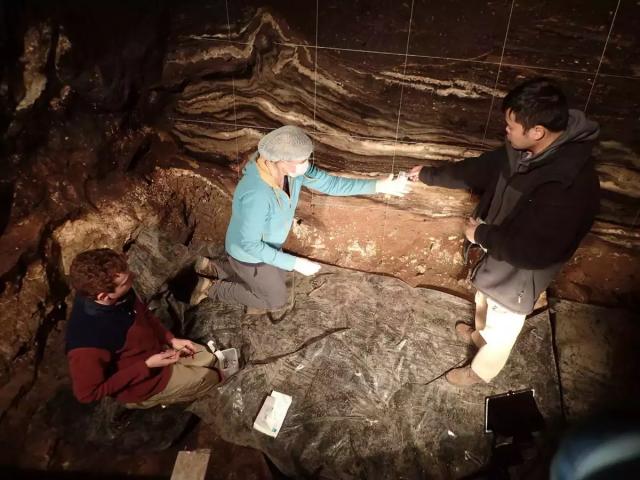
Researchers Zenobia Jacobs, Bo Li and Kieran O'Gorman during sample collection (Photo courtesy Dr. Richard G. Roberts. All rights reserved)

An article published in the journal “Nature” reports the results of the sequencing of DNA found in the sediments of the Denisova Cave, in Siberia. A team of researchers achieved the largest sequencing ever conducted on genomes recovered from sediments from a single site with 728 samples. The results offer a picture of the occupation of that cave over a period of more than 300,000 years by three human species: the Denisovans, the Neanderthals, and the Homo sapiens. However, most of the samples turned out to be DNA from various animals, which is also useful because it offers information on the connection between humans and the species that various populations ate.