
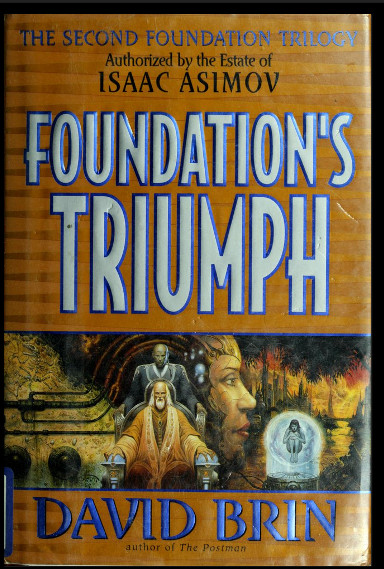
The novel “Foundation’s Triumph” by David Brin was published for the first time in 1999. It’s the third book of the so-called second Foundation trilogy and follows “Foundation and Chaos“.
Hari Seldon is supposed to have completed his task related to the creation of the Foundations but there are still some points of the psychohistory that give him headaches. A meeting with a person outside the project who suggests some connections between the characteristics of some planets’ soil and psychohistory intrigues him and drives him to start a journey that has an unexpected final destination.
The robot that used the name Dors Venabili meets Lodovik Trema, who gives her the head of R. Giskard Reventlov. Dors begins to relive Giskard’s memories, starting with the ones connected to R. Daneel Olivaw, who is carrying out a plan he reveals to his assistant Zun Lurrin.
“Foundation’s Triumph” concludes the second Foundation trilogy with what are presumably the last significant events in Hari Seldon’s life. Not much time has passed since the events of the second book and that also includes clashes between factions, especially robot factions.
The importance of robots is the direct consequence of the last written by Isaac Asimov but the factions and the related disagreements were created by the authors of the second trilogy. The Zeroth Law is at the center of the dispute but David Brin also exploits the other Laws of Robotics in the plot, drawing inspiration more than the other authors from all the stories of robots.
David Brin continues to develop the storylines begun in the previous books, including the one involving simulations of Voltaire and Joan of Arc. This end of the trilogy hasn’t eliminated my doubts about this part of the story, which in my opinion, weighed down the first book unnecessarily.
I found Hari Seldon’s journey more interesting, as it seems to be developed to complete the portrait of the decaying Galactic Empire. The situation on Trantor was the focus of previous novels and already offered insights into the Empire’s troubles. “Foundation’s Triumph” offers other points of view from inhabitants of planets far from the center of the Empire, also to tie in with the original stories set after its fall.
The expansion of the setting to include other planets is also used to show other aspects of the robots’ influence. From this point of view, the second trilogy shows a sick humanity, the price of millennia of stability. David Brin shows another layer of Daneel Olivaw’s plans that also connect the story to the sequels of the original trilogy written by Isaac Asimov.
For this reason, “Foundation’s Triumph” is not a rewrite of parts of the original stories or some sort of integration of those stories but is more forward-looking ending with a resolution that determines the fate of humanity. From this point of view, David Brin projects the possibilities of development even beyond the period narrated by Isaac Asimov.
It’s inevitable that this second Foundation trilogy is controversial. The authors developed Isaac Asimov’s ideas that had already made major changes to the Foundation series and each author added something of his own. In the end, the future after the fall of the Empire turns out to be very different from what one expected when reading the original trilogy.
In my opinion, if you accept the changes already made by Isaac Asimov, David Brin did a good job with “Foundation’s Triumph” by putting together the various threads of the great storyline developed over the decades. I recommend reading it especially to readers who enjoyed the previous novels of the second trilogy.
