
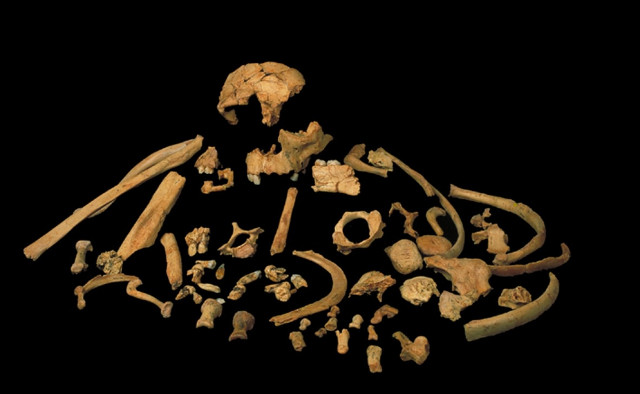
An article published in the journal “Nature” reports a study based on the extraction of proteins from a tooth about 800,000 years old attributed to the species Homo antecessor. A team of researchers used a mass spectrometry technique to obtain that information, very useful for a better understanding of the relationships among the various human species. The conclusion is that Homo antecessor could be closely related to the last common ancestor of Homo sapiens, Neanderthals and Denisovans.
Homo antecessor is a species proposed in an article published in the journal “Science” in June 1997 which reported a study of fossils discovered at the Gran Dolina site, in the Sierra de Atapuerca, Spain. Between 1994 and 1995, the archaeologist Eudald Carbonell and the paleoanthropologist Juan Luis Arsuaga discovered dozens of fossil fragments of hominins along with about 200 stone tools and 300 animal bones. According to the estimates, the hominin fossils belong to at least six individuals, mostly not yet adults. Various dating performed with various methods give approximate results between 770,000 and 940,000 years. In 2007 another excavation at the nearby site of Sima del Elefante unearthed more fossil fragments attributed to the same species.
The new species proposed by the two discoverers together with other researchers hasn’t been accepted by all scientists. The skeletons are very incomplete, particularly with regards to the skulls. The anatomical similarities with Homo sapiens derive mainly from characteristics found in the jaws of non-adult individuals, whose appearance might have changed significantly with growth. Skeptics claim that those fossils belong to a variant of primitive Homo erectus or Homo heidelbergensis.
To try to find evidence of their relationship with the most recent human species, which could also confirm the existence of the species Homo antecessor, the fossil discoverers, other members of the team that proposed that species, and other researchers from various scientific disciplines resorted to an extremely sophisticated technology. Mass spectrometry was used in what was called palaeoproteomics, which is the analysis of ancient proteins.
The palaeoproteomic approach is useful in the study of very ancient bones, in which the DNA has already degraded to the point that any sequencing is impossible. Proteins can last much longer and still provide very useful information because some are typical of a species, so the similarities help to reconstruct the relationships.
In particular, this study focused on the determination of the amino acid sequence, crucial for the comparisons with those of other species, in the tooth enamel proteins attributed to Homo antecessor. A team led by Enrico Cappellini from the University of Copenhagen, Denmark, developed this technique and participated in this study by analyzing a tooth attributed to Homo antecessor. The comparison included a Homo erectus tooth dated around 1.77 million years ago because proteins can last so long. The availability of DNA fragments from various individuals of the Neanderthal and Denisovan species enabled a broad comparison.
José María Bermúdez de Castro, scientific co-director of the excavations in the Sierra de Atapuerca sites, among the proponents of the Homo antecessor species, and among the authors of this study, explained that the conclusions of the examination of the fossil teeth indicates that this species could be closely related to the last common ancestor of Homo sapiens, Neanderthals and Denisovans. It also indicates that certain human characteristics seem to have evolved earlier than previously thought.
This result is important and opens the way for further studies based on the palaeoproteomic approach on the history of evolution of the various human species. The reconstruction of the hominin family tree is still far from complete, but this type of study can help a lot in understanding the various relationships.
