
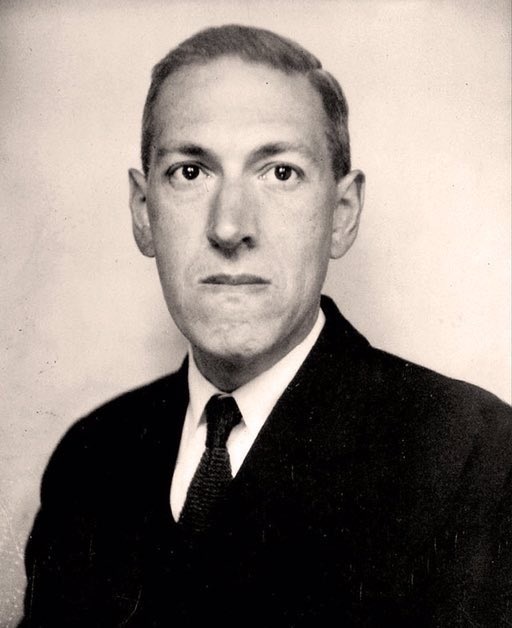
Howard Phillips Lovecraft was born on August 20, 1890, in Providence, Rhode Island, USA.
H.P. Lovecraft was only 3 years old when his father was admitted to a psychiatric hospital following psychotic behavior. There, he died five years later, when he was struck by paralysis, a typical symptom of advanced syphilis. His son always claimed that his illness was the result of insomnia and overwork.
For the rest of his childhood, H.P. Lovecraft grew up with his mother, his maternal aunts, and grandparents. His grandfather, Whipple Van Buren Phillips, was a fan of Gothic literature and encouraged his grandson to read this and other genres. His grandmother, Rhobinia, introduced him to astronomy, and her death caused him severe nightmares. His grandfather’s death created financial problems for the family, who had to move to a smaller house.
The various difficulties of his family caused the young H.P. Lovecraft’s first nervous problems, which prevented him from finishing his high school studies. Instead, they were an inspiration for his first experiments as a writer. Thanks to magazines such as “Argosy”, he also managed to establish contacts with writers with whom he maintained a constant correspondence.
H.P. Lovecraft’s work in the literary field started as a poet, manuscript reviewer, and journalist. In 1919, he published the short story “Dagon”, where he started developing the themes that would mark his career. For the occasion, he used a Mesopotamian deity, but in the following years, he started creating his own mythology.
In his private life, during the ups and downs of the various nervous problems that afflicted him, in 1921 H.P. Lovecraft met Sonia Green, whom he married in March 1924. Their marriage lasted about 4 years and was the only period during which the author lived away from his Providence.
During those years, H.P. Lovecraft wrote “The Dream-Quest of Unknown Kadath” and “The Case of Charles Dexter Ward”, but both works were published only posthumously.
After returning to Providence, H.P. Lovecraft was more active than ever, writing the cosmic horror stories that would make him famous to the general public. However, during his life, he had a remarkable network of contacts among writers, but his public success was limited, even for works later considered among his masterpieces such as “The Shadow over Innsmouth”.
The suicide of his friend and colleague Robert E. Howard was for H.P. Lovecraft another blow in a life full of tragedy. His health deteriorated, and a doctor diagnosed him with cancer of the small intestine. On March 15, 1937, Lovecraft died of complications from that disease.
Some works of H.P. Lovecraft were published posthumously and over time rose to fame. The so-called Cthulhu Mythos, which includes works that mention a pantheon of deities and various totally alien creatures, became the most important part of the author’s works. They include elements of science fiction, fantasy, and horror, and ended up influencing generations of writers in those genres.
During his lifetime, H.P. Lovecraft was relatively unknown to the public, but today he’s considered one of the most influential writers of the 20th century in the various speculative fiction genres. His works have been the subject of studies and analyses, but also of controversies over some of his positions, such as on the race theme. He’s an author who left his nightmares as his legacy.
