Various articles report the results of separate studies on fossils belonging to species of the genus Homo whose identification is based on fossils discovered in China and Israel, respectively. In both cases, the publication caused controversy. Three articles, available here, here, and here, published in the journal “The Innovation” report various aspects of the identification of what was named Homo longi, based on a skull dated at least 146,000 years discovered in modern-day China. Three articles published in the journal “Science” report various aspects of the identification of a population that belongs to the genus Homo for now indicated only as Homo from Nesher Ramla, based on fossils dated between 120,000 and 140,000 years ago.
Two studies published almost simultaneously about fossils of hominins that lived in the Middle Pleistocene period show how difficult it can be to attribute isolated bones to a species. In this case, it’s a skull for what was named Homo longi and some skull fragments for what was named Homo from Nesher Ramla. The complexity of the history of humanity revealed in recent years, with the inclusion of various interbreedings, increases the difficulties in attributing limited fossils and the controversies that can arise from the proposal of a new species.
The skull discovered in modern-day China, in the city of Harbin in 1933 (Top image courtesy Ni et al. All rights reserved), is almost complete. This allowed the researchers who studied it to describe the various characteristics, some similar to those of Homo sapiens and some archaic. For this reason, the name Homo longi was proposed considering it a new species closer to Homo sapiens than Neanderthals.
Other scientists proposed the possibility that the skull discovered in China belongs to an already known species, the Denisovans. The difficulty in this attribution is due to the fact that very few bones belonging to this species are known. The Denisovans are considered a species separate from Homo sapiens and Neanderthals following genetic analysis. In fact, most of their bones were discovered in Siberia, where conditions allowed for excellent preservation and success in DNA extraction. Many modern Asian populations inherited genes from the Denisovans following various interbreedings, so it wouldn’t be a surprise to find their fossils in China.
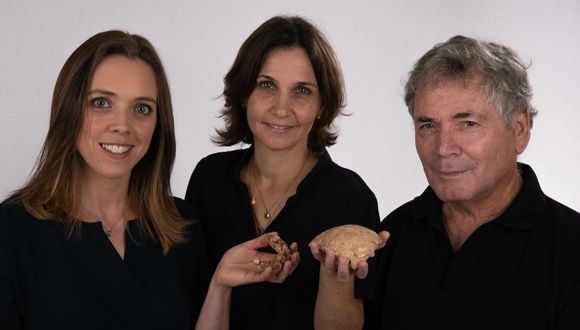
In the case of the skull fragments discovered in modern-day Israel, the situation is even more complicated. The bottom photo (Courtesy Tel Aviv University. All rights reserved) shows Dr. Rachel Sarig, Dr. Hila May, and Professor Israel Hershkovitz with the few skull fragments discovered at the Nesher Ramla site. Researchers are cautious in attribution, aware of the difficulties. These fossils were discovered along with animal bones and artifacts that show typical signs of the Levallois technique for shape stone tools. Other fossils discovered in the same region may belong to the same population.
The researchers who have studied Israeli fossils and artifacts propose the possibility of a population that was the result of interbreedings between different groups that passed through the Middle East at different times. Surely, Neanderthals lived in Israel and recent studies indicate that even groups of Homo sapiens may have arrived in that region about 200,000 years ago. In short, the Nesher Ramla population might have been a mixture of different groups of Neanderthals and Homo sapiens that interbred over a very long period.
The Levallois technique has been associated with both Neanderthal and Homo sapiens groups, therefore it doesn’t offer crucial information for the attribution. According to some scientists, the characteristics of the bones studied could be included in the variability of Neanderthal traits. In short, it could be an interesting population from the paleoanthropological and archaeological point of view but nothing that can shake the human evolutionary tree.
Discussions around any potentially important human fossil discovery are normal. In this case, there’s the coincidence of studies concerning two very distant populations that were published almost simultaneously to stress the problems deriving from the complex history of humanity, made up of migrations and interbreedings between populations, even of different species.
Discussions around the Harbin skull and Nesher Ramla skull fragments will continue thanks to the opportunity to analyze the published data. They might belong to already known species of hominins but would still offer new insights into the history of humanity.