Biology

An article recently published in the journal “Nature” describes the study of the DNA of hominids found in a place in northern Spain called Sima de los Huesos, which means pit of bones. The DNA analysis of these fossils of hominids who lived between 300,000 and 400,000 years ago established that they are an early form of Neanderthals. According to paleogeneticist Matthias Meyer of the Max Planck Institute for Evolutionary Anthropology in Leipzig, Germany, the results suggest that the ancestors of homo sapiens separated from those of the Neanderthals and another species called Denisovans between 550,000 and 765,000 years ago.

Diagram of the possible mechanism for CRISPR (Image courtesy James Atmos)

An article just published in the journal “Cell” describes a study that led to the discovery of a new way to modify DNA. A team of the the Broad Institute led by biologist Feng Zhang found an enzyme that allows for more precise DNA editing more easily than existing ones. This system, called CRISPR-Cpf1, could represent a significant step forward compared to the CRISPR-Cas9 system, already considered revolutionary.

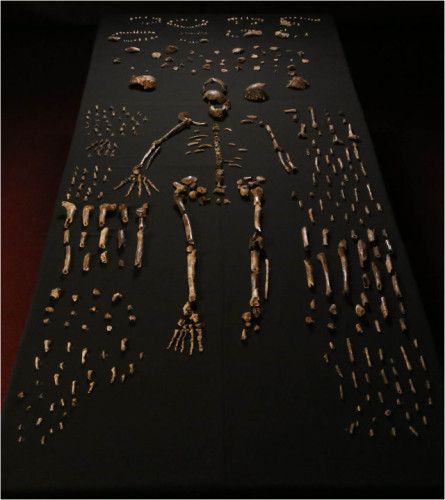
Part of the bones of the hominids called Homo naledi discovered in South Africa (Photo Lee Berger and colleagues)

An article published in the online magazine “eLife” describes the discovery of about 1,500 pieces of bones from at least 15 individuals in a cave called Rising Star about 50 kilometers northwest of Johannesburg, South Africa. According to the researchers, it’s a species related to humans unlike any known one they called Homo naledi. Another article will be published in the October issue of the magazine “National Geographic”. However, the classification of these fossils has already generated some controversy.

Artistic representation of a Pentecopterus decorahensis (Image courtesy Patrick Lynch / Yale University. All rights reserved)

An article in the journal “BMC Evolutionary Biology” describes the discovery of fossils of Pentecopterus decorahensis, a sea scorpion that lived in the Ordovician period, about 467 million years ago, in Iowa. It was huge by arthropods standards because it’s estimated that its length could reach 180 cm (almost 6 feet). It’s in fact one of the largest arthropods ever lived and according to James Lamsdell, the lead author of this study, was part of a group of important predators in the Paleozoic era.

Xandarella spectaculum examined at light and fluorescence microscopy (Image courtesy Yu Liu)

A study published in the journal “Scientific Reports” describes the use of computed microtomography (micro-CT) to reveal anatomical details preserved in fossil slabs. A team of researchers at the Ludwig-Maximilians-Universität (LMU) in Munich, Germany, led by Dr. Yu Liu showed that it’s possible to use non-invasive methods to study fossils without damaging them.