Biology

California two-spot octopus (Octopus bimaculoides) (Photo Jeremy Selan)

An article published in the journal “Nature” describes a research on octopuses. The DNA of a speciment that belongs to the species California two-spot octopus (Octopus bimaculoides), which lives off the coast of California, has been sequenced, the first case involving an animal belonging to the class of cephalopods. Octopuses are very different from all vertebrates, so much as to be defined aliens by various scientists, and showed remarkable intelligence. This species has about 33,000 protein-encoding genes, while humans have fewer than 25,000.

Catopsbaatar catopsaloides, an ancient mammal that belonged to the multituberculates order

An article published in the journal “Current Biology” describes a research showing that there was a rapid evolution of mammals during the Jurassic period, between 200 and 145 million years ago. That period and in general the Mesozoic era, between 252 and 66 million years ago, were the dinosaurs era so we tended to think that mammals lived in their shadow, in ecological niches, such as nocturnal insectivores. Instead, the discovery of new fossils in recent years showed a series of adaptations with a previously unknown diversification.

Aegirocassis benmoulai fossil and scheme

An article recently published in the “Journal of the Geological Society” describes a research on the fossils of the Lower Fezouata formation in the south-east of Morocco, a deposit discovered only five years ago. These fossils shed light on the evolution of many families of animals in the Ordovician period, between 485 and 444 million years ago. In particular, it shows that some of the oldest animals survived millions of years longer than it was inferred from previously found fossils.

In recent days, Google and the Broad Institute, a genomics and biomedical research center founded by MIT (Massachusetts Institute of Technology) and Harvard University, announced a collaboration in the field of genomics. The Broad Institute’s Genome Analysis Toolkit (GATK) will be offered as a service of Google’s Cloud Platform as part of the Google Genomics project. This will allow researchers to combine the center’s tools of genomic analysis with Google’s computing power.

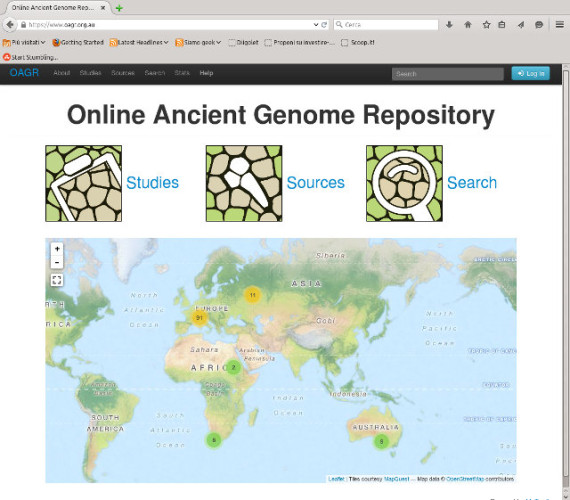
The Online Ancient Genome Repository (OAGR) website home page

The Online Ancient Genome Repository (OAGR) website is online. It’s an open access database created by the University of Adelaide’s Australian Centre for Ancient DNA (ACAD). The website is designed to collect and provide open access to a collection of DNA data from skeletons of ancient humans but also of microbes found in their dental plaque. This will enable scientists and teachers around the world to use these data for research and educational purposes.