Biology

Carbonate-rich lakes as possible places where life on Earth originated

An article published in the journal “Proceedings of the National Academy of Science” reports a study on carbonate-rich lakes as possible places where life on Earth originated. Jonathan Toner and David Catling of the University of Washington measured the concentration of phosphorus, an element crucial for various cellular processes, in carbonate-rich lakes, detecting phosphorus concentrations up to 50,000 times higher than those present in seawaters, in river waters and also in those of other lakes. The two researchers found a link between an abundance of carbonates and phosphorus, a discovery that offers a possible solution to the problem of the shortage of phosphorus in other possible places of origin of life.

The Cancer Dependency Map (Cancer DepMap) Portal's home page

An article published in the journal “Nature Communications” reports the verification of the consistency of two datasets containing information on the application of a CRISPR-Cas9 system to obtain genetic modifications of cancer cells within research on their genetic alterations. A team of researchers from the Wellcome Sanger Institute and the Broad Institute of MIT and Harvard compared the consistency of the two datasets, independently verifying the methodology and findings and validating 725 cancer models covering 25 different types of cancer. This is very useful information to understand the importance of the various genes in the survival of cancer cells and to create targeted treatments in a strategic collaboration called Cancer Dependency Map (Cancer DepMap).

A genetic editing tool based on a jumping gene for more reliable results

An article published in the journal “Nature” reports the use of cryo-electron microscopy to capture images of a genetic modification tool called INTEGRATE in the course of its work. A team led by Sam Sternberg of Columbia University applied this technique that uses a transposon to improve the results of a CRISPR-Cas system thanks to its ability to reliably insert DNA sequences into a genome. In essence, the use of a transposon eliminates the potential errors that CRISPR-Cas systems can create by cutting DNA.

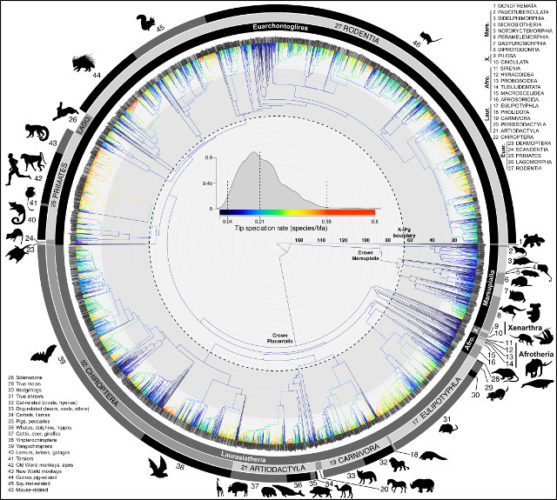
A new family tree of mammals to reconstruct their history and relationships

An article published in the journal “PLOS Biology” reports an analysis of the information available on the relationships among mammal species that aims to build an evolutionary family tree of this group of animals. Nathan Upham and Walter Jetz of Yale University together with Jacob Esselstyn of Louisiana State University used data on fossils and genomics to try to analyze at phylogenetic level the evolution of the various branches within the mammal taxonomic class. Understanding their relationships offers information on their history and biodiversity, a crucial step for environmental conservation.

Some meteorite NWA 1172's dust fragments colonized by Metallosphaera sedula (Image courtesy Tetyana Milojevic)

An article published in the journal “Scientific Reports” describes a study on the ability of a species of archaea called Metallosphaera sedula to grow into typical meteorite materials using the metals they contain as an energy source. A team of researchers led by astrobiologist Tetyana Milojevic of the University of Vienna examined these archaea living and interacting with a real meteorite. The results can provide clues to the origin of life on Earth thanks to the possibility of identifying with greater certainty microfossils containing metals. This also means having better chances of evaluating possible traces of microscopic life found in other places in the solar system.