Paleontology

Cyanobacteria of the species Prochlorococcus marinus

An article published in the journal “Proceedings of the Royal Society B: Biological Sciences” reports the results of a study on the origin of oxygenic photosynthesis. A team of researchers developed a new gene analysis technique to estimate the origin of cyanobacteria capable of oxygenic photosynthesis. The conclusion is that all the species of these cyanobacteria existing today have a common ancestor that dates back to about 2.9 billion years ago and that the ancestors of cyanobacteria branched off from other bacteria about 3.4 billion years ago. Oxygenic photosynthesis probably evolved during that time interval.

Views of Titanokorys gainesi fossils (Image courtesy Jean-Bernard Caron, Royal Ontario Museum)

An article published in the journal “Royal Society Open Science” reports the identification of a new species of radiodont that was named Titanokorys gainesi dating back to about half a billion years ago thanks to fossils discovered in the famous Burgess Shale. A team of researchers examined what is the largest radiodont of the Hurdiidae family discovered so far and in particular the large carapace that covered its head, which is very long compared to its body. Such an animal must have been of considerable importance in its ecosystem, like other predatory radiodonts of the Cambrian period. Its discovery helps to understand the diversification of these arthropods and in particular of the ones of the Hurdiidae family, which had a great variability in the characteristics and in particular of the carapace.

The specimen of Tupandactylus navigans with the drawing indicating its bones (Image Beccari et al)

An article published in the journal “PLoS ONE” reports the attribution of an almost complete pterosaur skeleton to the Tupandactylus navigans species. This fossil skeleton arrived in the hands of a team of researchers led by Dr. Victor Beccari in an adventurous way, as it was confiscated by the police along with other very well-preserved fossils during a raid at Santos Harbour, Brazil. The researchers subjected the skeleton to a CT scan that made it possible to create a 3D reproduction. The examination also led to the hypothesis that Tupandactylus navigans and Tupandactylus imperator actually constitute the two sexes of the same species.

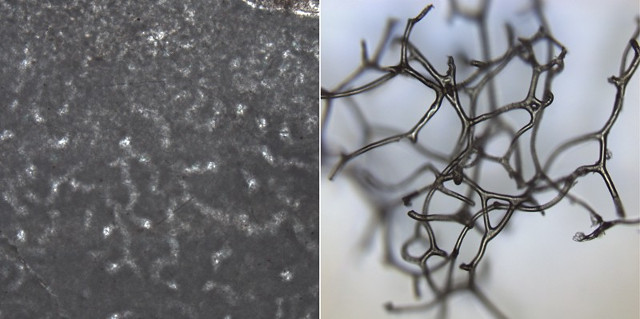
890 million-year-old fossil structures on the left and the "skeleton" of a modern sponge on the right

An article published in the journal “Nature” reports a study on microfossils with structures similar to those of modern sponges that have an estimated age of about 890 million years, much older than any fossil attributed with certainty to animals. Geologist Elizabeth Turner of Laurentian University, Canada, studied microfossils from an area of ​​northwestern Canada known for Precambrian fossils, part of the Stone Knife Formation. This study has already divided paleontologists due to the difficulty of ruling out that these are fossils of different origin or even false fossils generated by some type of crystallization.

Some of the microfossils discovered (Image courtesy B. Cavalazzi)

An article published in the journal “Science Advances” reports the discovery of microfossils of the oldest known methanogenic microorganisms, with an estimated age of 3.42 billion years. A team of researchers led by Professor Barbara Cavalazzi of the University of Bologna, Italy, discovered these microfossils in South Africa, in the area known as the Barberton Greenstone Belt. These microorganisms lived in a system of hydrothermal veins and show similarities with today’s archaea. Their study offers insights into early life forms on Earth and the possibilities for life forms to emerge in similar environments elsewhere in the universe.