Paleontology

A reconstruction of Leti's skull in Professor Berger's hand

Two articles published in the journal “PaleoAnthropology” report as many studies connected to Homo naledi, the species of hominins whose fossils were discovered in the cave called Rising Star about 50 km northwest of Johannesburg, South Africa. One of the two articles reports the study of a partial skull with some teeth belonging to an individual who was still in the growth phase, possibly a child. The other article reports the results of the exploration of the subsystem of the cave called Dinaledi. These studies offer new insights into what Professor Lee Berger, who led the team that conducted the first studies on Homo naledi, called an enigmatic species.

The Bodo 1 skull (Image courtesy Jeffrey H. Schwartz / Roksandic et al.)

An article published in the journal “Evolutionary Anthropology” reports a research on hominins of the Middle Pleistocene period that proposes the species Homo bodoensis as a classification for a series of hominin fossils discovered in Africa and some discovered in some areas of Europe. A team of researchers led by paleoanthropologist Mirjana Roksandic of the University of Winnipeg, Canada, reached this conclusion after reassessing fossils discovered over the years in Africa and Eurasia. A consequence of this proposal is the elimination of the species Homo heidelbergensis and Homo rhodesiensis with their often inconsistent definitions. A series of fossils attributed to the species Homo heidelbergensis would be Neanderthals.

Terropterus xiushanensis fossils and drawings

An article published in the journal “Science Bulletin” reports the identification of Terropterus xiushanensis, a species belonging to the order of the eurypterids (Eurypterida), the so-called sea scorpions, which lived about 435 million years ago, during the Silurian period, in today’s China. A team of researchers examined several fossils discovered in the Xiushan Formation and concluded that it belongs to a genus from the ones known and attributed it to the Mixopteridae family. It’s the first sea scorpion attributed to that family discovered in China.

Fossils of African mammals

An article published in the journal “Communications Biology” reports a study on a hitherto unknown mass extinction of mammals that occurred in Africa and the Arabian Peninsula between the end of the Eocene period and the beginning of the Oligocene period. A team of researchers led by Dorien de Vries of the University of Salford mainly used the Duke University fossil collection to establish that an extinction affecting Europe and Asia after climate change that led to significant cooling had also affected warmer areas. Some important geological events contributed to the decline of mammals in those areas.

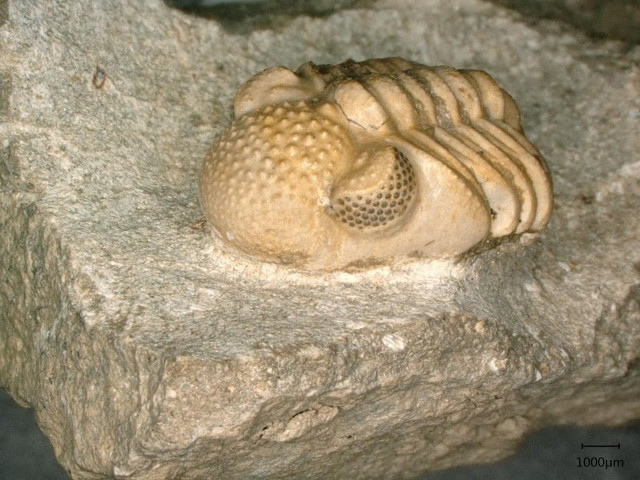
Trilobite of the order Phacopida (Photo courtesy Brigitte Schoenemann)

An article published in the journal “Scientific Reports” reports a study on the eyes of the trilobites of the Geesops schlotheimi species, which lived about 390 million years ago. A team of researchers led by zoologist Brigitte Schoenemann examined fossils of this trilobite and old X-ray images of fossils to study its eyes. The structure of those eyes is peculiar even among trilobites and exists only in the order Phacopida: it features a small number of relatively large, well-separated, lenses, each covered by its own cornea. It’s a sophisticated structure that perhaps was useful for seeing in low light.