Paleontology

Harbin Cranium

Various articles report the results of separate studies on fossils belonging to species of the genus Homo whose identification is based on fossils discovered in China and Israel, respectively. In both cases, the publication caused controversy. Three articles published in the journal “The Innovation” report various aspects of the identification of what was named Homo longi, based on a skull dated at least 146,000 years discovered in modern-day China. Three articles published in the journal “Science” report various aspects of the identification of a population that belongs to the genus Homo for now indicated only as Homo from Nesher Ramla, based on fossils dated between 120,000 and 140,000 years ago.

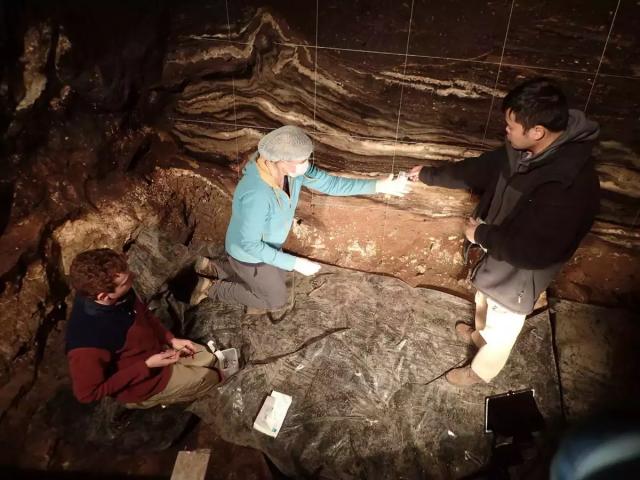
Researchers Zenobia Jacobs, Bo Li and Kieran O'Gorman during sample collection (Photo courtesy Dr. Richard G. Roberts. All rights reserved)

An article published in the journal “Nature” reports the results of the sequencing of DNA found in the sediments of the Denisova Cave, in Siberia. A team of researchers achieved the largest sequencing ever conducted on genomes recovered from sediments from a single site with 728 samples. The results offer a picture of the occupation of that cave over a period of more than 300,000 years by three human species: the Denisovans, the Neanderthals, and the Homo sapiens. However, most of the samples turned out to be DNA from various animals, which is also useful because it offers information on the connection between humans and the species that various populations ate.

Artist's reconstruction of Australotitan cooperensis (Image courtesy Vladislav Konstantinov / Scott Hocknull)

An article published in the journal “Peer J” reports the identification of the largest dinosaur species that lived in today’s Australia. A team of researchers named Australotitan cooperensis this dinosaur that lived in the Cretaceous period, between 92 and 96 million years ago, and included it in the group of titanosaurs, the giant long-necked herbivores that include the largest animals that lived on land. The identification represents the culmination of a long task on the scattered bones of various specimens.

Pestera Muierii 1 skull (Photo courtesy Mattias Jakobsson)

An article published in the journal “Current Biology” reports the sequencing of the whole genome of the woman who lived about 35,000 years ago in today’s Romania and is referred to as Pestera Muierii 1. A team of researchers led by Professor Mattias Jakobsson of Uppsala University, Sweden, successfully conducted the first complete sequencing of this woman’s DNA. It’s one of the very few complete genomes of people who lived over 30,000 years ago. Its genetic diversity compared to today’s humans suggests that some of it was lost during the Ice Age and not in the migration from Africa.

Bicellum brasieri fossils

An article published in the journal “Current Biology” reports the discovery of an organism dating back to about a billion years ago that lived in present-day Scotland and showed a cell differentiation typical of multicellular organisms. A team of researchers discovered microfossils in the Diagbaig Formation and named this species Bicellum brasieri. The examination led to the conclusion that it could be an organism of the Holozoa group, which includes animals and their closest single-celled relatives. If confirmed, this is the discovery of the oldest known multicellular organism, perhaps even the oldest that ever existed, and could be a new link in the evolutionary history that led to the emergence of animals.