Paleontology

The Homo erectus known as Java Man

An article published in the journal “Nature Ecology & Evolution” reports a genetic study on populations of Island Southeast Asia that shows the presence in their DNA of genes inherited from the Denisovans, another human species now extinct, but no trace of interbreedings with other hominins of which there are fossils. A team of researchers led by Dr João Teixeira of the Australian University of Adelaide examined the DNA of 426 people from 10 different populations looking for possible traces of interbreedings with so-called super-archaic populations but without results.

Oviraptorid brooding its nest of eggs

An article published in the journal “Science Bulletin” reports the discovery of fossils of a species of feathered dinosaur attributed to the oviraptorid family that include a partial skeleton of an adult that was brooding a group of 24 eggs, some of which were broken and showed bones still in their embryonic state. A team of researchers conducted the first study of these fossils dating back to about 70 million years ago, during the Cretaceous period, discovered in the Nanxiong Formation, near the city of Ganzhou, China. This is the first discovery of a non-avian dinosaur while it was brooding a nest with eggs that preserved their embryos.

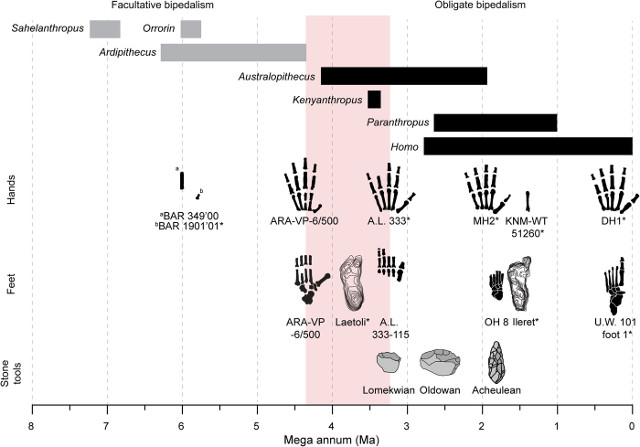
A scheme of the evolution of the hands and feet of hominins

An article published in the journal “Science Advances” reports a study of the hands of Ardipithecus ramidus, a hominin that lived about 4.4 million years ago. Thomas Cody Prang, a professor of anthropology at Texas A&M University, and some colleagues examined the particularly well-preserved fossil hands of the specimen nicknamed Ardi. A comparison with the hands of modern humans, apes, and monkeys provided new insights into their evolution and connection with their locomotion showing a correlation between the evolution of hand and foot characteristics.

Artist's reconstruction of the steppe mammoth (Image courtesy Beth Zaiken / Centre for Palaeogenetics)

An article published in the journal “Nature” reports the sequencing of DNA fragments of some mammoth specimens even older than one million years. A team of researchers used advanced paleogenetic techniques to extract DNA from three teeth discovered in the 1970s, one from an early woolly mammoth and two assigned to the species it descended from, known as the steppe mammoth. These are the oldest genomes sequenced so far, and indicate among other things that the mammoth that inhabited North America during the last ice age was a hybrid between the woolly mammoth and mammoths belonging to a hitherto unknown genetic line. These findings offer new insights into the evolution of mammoths and their adaptation to cold climates.

The possible fossil fungi discovered in the Doushantuo Formation (Image courtesy Andrew Czaja of University of Cincinnati.)

An article published in the journal “Nature Communications” reports the discovery in the Doushantuo Formation in China of microfossils dating back to about 635 million years ago attributed to a fungus-like organism. A team of researchers led by Professor Shuhai Xiao of Virginia Tech University examined these microfossils that could belong to the fungi that colonized the mainland in the Ediacaran period. They might also have contributed to the Earth’s recovery after a so-called snowball Earth period, an ice age that covered the entire planet.